A Big Step, for a Specific Situation
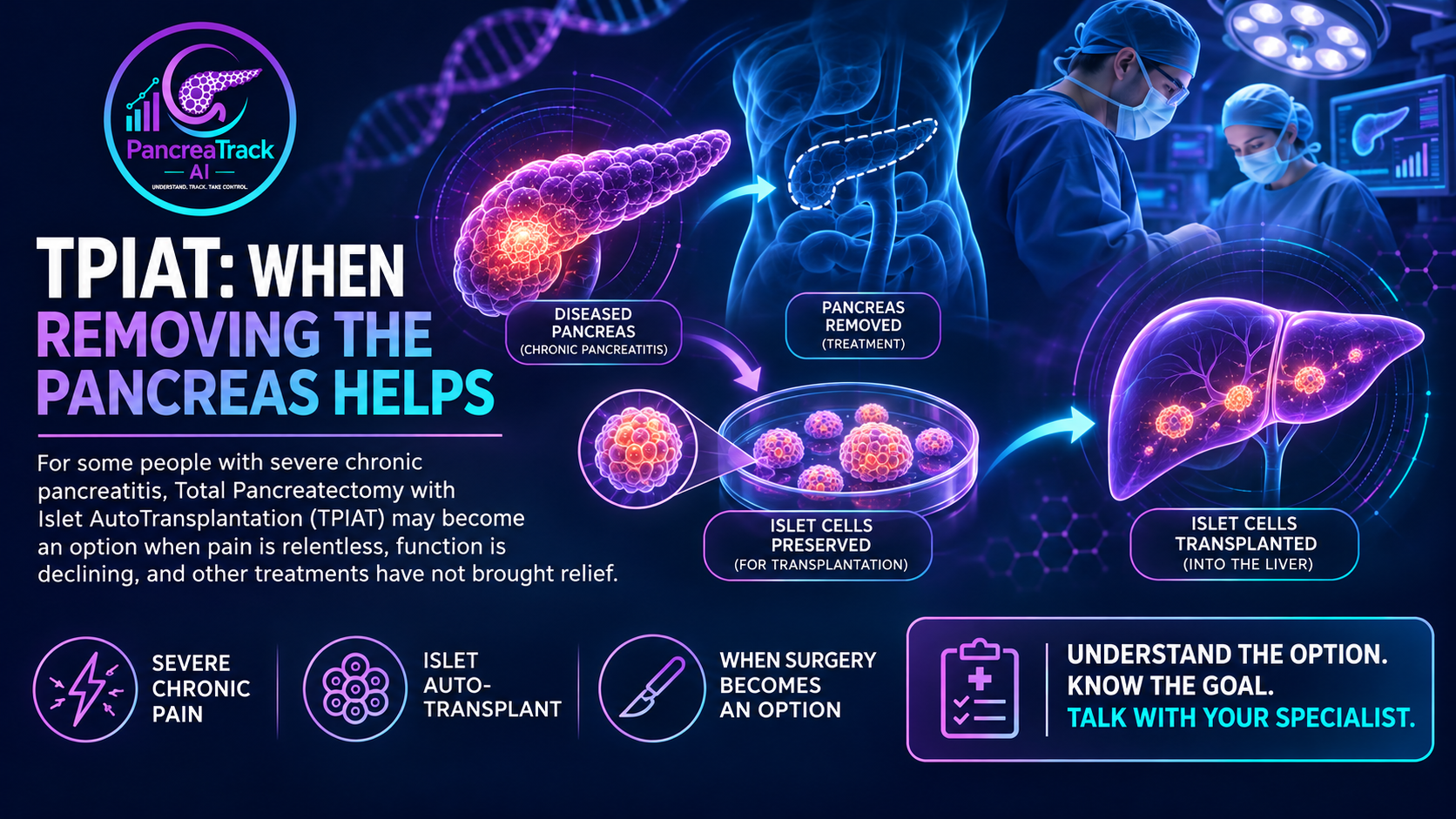
TPIAT stands for total pancreatectomy with islet autotransplantation. In plain terms: the whole pancreas is removed, and the insulin-producing islet cells from that pancreas are put back into the body — in the liver — so they can keep making insulin.
It is major surgery, and it is not for most people with pancreatitis. It is considered when chronic pancreatitis — or recurrent acute pancreatitis — causes severe, debilitating pain that has not improved with other treatments, and quality of life has fallen sharply. The goal is pain relief and a better quality of life, while giving the body the best chance of avoiding diabetes after the pancreas is gone.
If you have heard the term and wondered whether it applies to you, this post explains what the surgery involves, who it is for, and what life after it looks like. It is general information, not medical advice — TPIAT is a decision made with a specialist pancreas team, never on your own.
What Happens in a TPIAT
TPIAT is two steps in one operation, usually lasting 6 to 10 hours:
- Total pancreatectomy. The entire pancreas is removed, along with the duodenum (the first part of the small intestine) and the spleen, and the digestive tract is reconstructed. The gallbladder and appendix are often removed as well.
- Islet autotransplantation. The removed pancreas is taken to a laboratory, where its islet cells — the cells that make insulin — are isolated. Those islets are then infused into the liver through the portal vein, the blood vessel that carries blood to the liver. The hope is that the islets settle in the liver and keep producing insulin there, as they did in the pancreas. It can take months to know how well they are working.
The "auto" in autotransplantation matters: the islets are your own cells, so immunosuppression — the drugs transplant patients usually take to stop rejection — is generally not needed.
TPIAT is done only at specialist centres, by surgeons experienced in the procedure. Not every hospital offers it, and not every patient with pancreatitis is a candidate.
Who It Is For — and Who It Is Not For
TPIAT is usually considered when:
- pain from chronic or recurrent acute pancreatitis is severe and debilitating, and has not responded to medical management — pain medicines, enzyme replacement, diet changes, or endoscopic procedures
- other reasonable treatments have already been tried
- there are still functioning islet cells to save — ideally, the patient is not already diabetic
- pancreatic cancer or another malignancy has been ruled out
- the patient is fit enough for major surgery and a long recovery
Almost half of the people who go through a full TPIAT evaluation turn out not to be candidates, according to specialist centres — so an evaluation is not a promise of surgery, and a "no" is a real and common outcome. The decision is made by a multidisciplinary team — surgeon, gastroenterologist, endocrinologist, dietitian, and others — and it usually has to be unanimous.
TPIAT is not a first step, and it is not a shortcut. It is what specialist teams consider when the pain itself has become the main problem and nothing less has worked.
What Recovery Looks Like
Recovery from TPIAT is long, and it helps to know that going in:
- Hospital stay: usually about 7 to 14 days, including a few days in intensive care.
- Full recovery: estimated at up to a year. The first weeks are the hardest, and energy, appetite, and strength return gradually.
- Insulin: everyone needs insulin in the short term after surgery, while the transplanted islets settle. Over time, the picture varies: some people — roughly a third at some centres — end up not needing insulin at all, while others need it long term. The outcome depends largely on how many healthy islets could be recovered and transplanted. Figures differ between centres, so a specialist team will talk through the odds for an individual case rather than a single number.
- Enzymes for life: with no pancreas, the body no longer makes digestive enzymes. Pancreatic enzyme replacement therapy (PERT) is needed with every meal, for life.
- Pain: most people report substantially less pain after TPIAT — around 85% report significantly less pain in patient-organisation figures, with other centres reporting substantial relief in roughly 70–80% of patients. Pain does not disappear for everyone, and some people still need pain management afterwards.
- Lifelong follow-up: regular appointments with the surgical team, an endocrinologist, and a gastroenterologist, plus lifelong monitoring of blood sugar, nutrition, and weight.
That is a lot to take in, and it is why the evaluation process is so thorough. The team is not only deciding whether the surgery can be done — they are making sure the person going into it understands what life on the other side looks like.
What to Track — Before and After
Whether TPIAT is on the table or already behind you, the log that helps your care team is the same combined one PancreaTrack is built for:
- Pain score (1–10), with the time and what you were doing — before surgery, this is the record that shows how severe and how constant the pain really is; after surgery, it shows whether pain is genuinely easing
- Glucose readings, before and after meals — especially important after TPIAT, when insulin needs are changing and the transplanted islets are still settling
- Insulin doses and timing, if you are using insulin
- Enzyme doses and timing (PERT) — what you took, and whether it was with the meal
- Meals — what you ate, roughly how much, and whether it was fatty or hard to digest
- Weight — a slow downward trend is easy to miss without a record, and it matters after major surgery
- Symptoms after eating — bloating, nausea, oily or greasy stools, and any shaky or sweaty episodes that might have been a low blood sugar
Over weeks and months, that log shows what a single appointment cannot: whether pain is trending down, whether blood sugar is stabilising, whether enzyme timing is working, and whether weight is recovering. That is the evidence a specialist team needs — and it is the record that makes a long, slow recovery easier to see clearly.
Questions Worth Asking Your Team
If TPIAT has been mentioned to you, these are reasonable questions to bring to your specialist team:
- Am I a candidate, and what would the evaluation involve?
- What are the chances, in my case, of being insulin-free afterwards — and what would insulin management look like if I am not?
- What does recovery look like in the first month, and in the first year?
- Which centre would do the surgery, and how experienced is the team with TPIAT?
- What support is available afterwards — dietitian, diabetes team, pain management?
- What should I be tracking now, so the team has the clearest picture when they decide?
No question about major surgery is a silly one. If the answers are unclear, ask again — or ask for them in writing.
When to Call Your Doctor
Get urgent medical care for:
- severe abdominal pain that your usual measures do not touch
- vomiting that will not stop, or being unable to keep fluids down
- fever over 100.4°F (38°C), or shaking chills
- yellowing of the skin or eyes (jaundice)
- a racing heartbeat, dizziness, or confusion
- signs of very low blood sugar that do not lift after treatment, or a low that leaves you confused or unable to help yourself
- pain that is rapidly getting worse instead of plateauing
And get checked soon — not urgently, but do not put it off — if you notice unexplained weight loss, repeated lows, or symptoms that are new or worsening. If you are ever unsure, err on the side of being evaluated. The U.S. National Library of Medicine provides an overview of pancreatitis symptoms and complications for patients who want to learn more, and the National Pancreas Foundation offers educational resources on living with pancreatitis and communicating with your care team.
Why This Matters
TPIAT is a hopeful option, but it is also a serious one — major surgery, a year of recovery, enzymes for life, and no guarantee about insulin. Knowing what it actually involves, before the conversation with a specialist team, makes that conversation better: you go in knowing the right questions, and you come out with a clearer sense of whether it fits your situation.
At PancreaTrack, we built our tracking tools for exactly that kind of long, complicated picture: quick pain, meal, enzyme, and glucose logging that takes seconds on a bad day, and turns into clear trends and doctor-ready summaries when you need them — so the next appointment starts with the whole story, pancreas included.
Sources
- Mission: Cure – Total Pancreatectomy with Islet Autotransplantation (TPIAT). https://mission-cure.org/managing-pancreatitis/tpiat/
- Cincinnati Children's Hospital Medical Center – Total Pancreatectomy with Islet Autotransplantation (TPIAT). https://www.cincinnatichildrens.org/service/p/pancreas-care/treatments/tpiat
- UC Health – Total Pancreatectomy with Islet Autotransplantation. https://www.uchealth.com/en/treatments-and-procedures/total-pancreatectomy-with-Islet-autotransplantation
- Dartmouth Health, Walter and Carole Young Pancreas Center – Total Pancreatectomy with Islet Auto Transplantation (TPIAT). https://www.dartmouth-hitchcock.org/pancreas-center/tpiat
- U.S. National Library of Medicine (MedlinePlus) – Pancreatitis. https://medlineplus.gov/pancreatitis.html
- National Pancreas Foundation – Pancreatitis educational resources.
*⚕️ Medical Disclaimer: PancreaTrack is a health tracking tool designed to help patients log and organize their symptoms — it is not a substitute for professional medical advice, diagnosis, or treatment. Always consult your physician or a qualified healthcare provider if you are experiencing pain, new symptoms, or any change in your condition. Never disregard professional medical advice or delay seeking it because of something you have read on this site.*