When the Pancreas Stops Making Enough Enzymes
Your pancreas does two jobs: it makes hormones that control blood sugar, and it makes digestive enzymes that break down food. In chronic pancreatitis, the same damage that can lead to Type 3c diabetes can also reduce enzyme production — a condition called exocrine pancreatic insufficiency, or EPI.
When enzymes run short, food is not fully digested. Fat is the hardest hit, because the pancreas makes lipase, the enzyme that digests fat — along with protease for protein and amylase for carbohydrate. The result is familiar to many people with chronic pancreatitis: bloating after meals, pain, loose or oily stools, and weight that drifts down even when appetite seems normal.
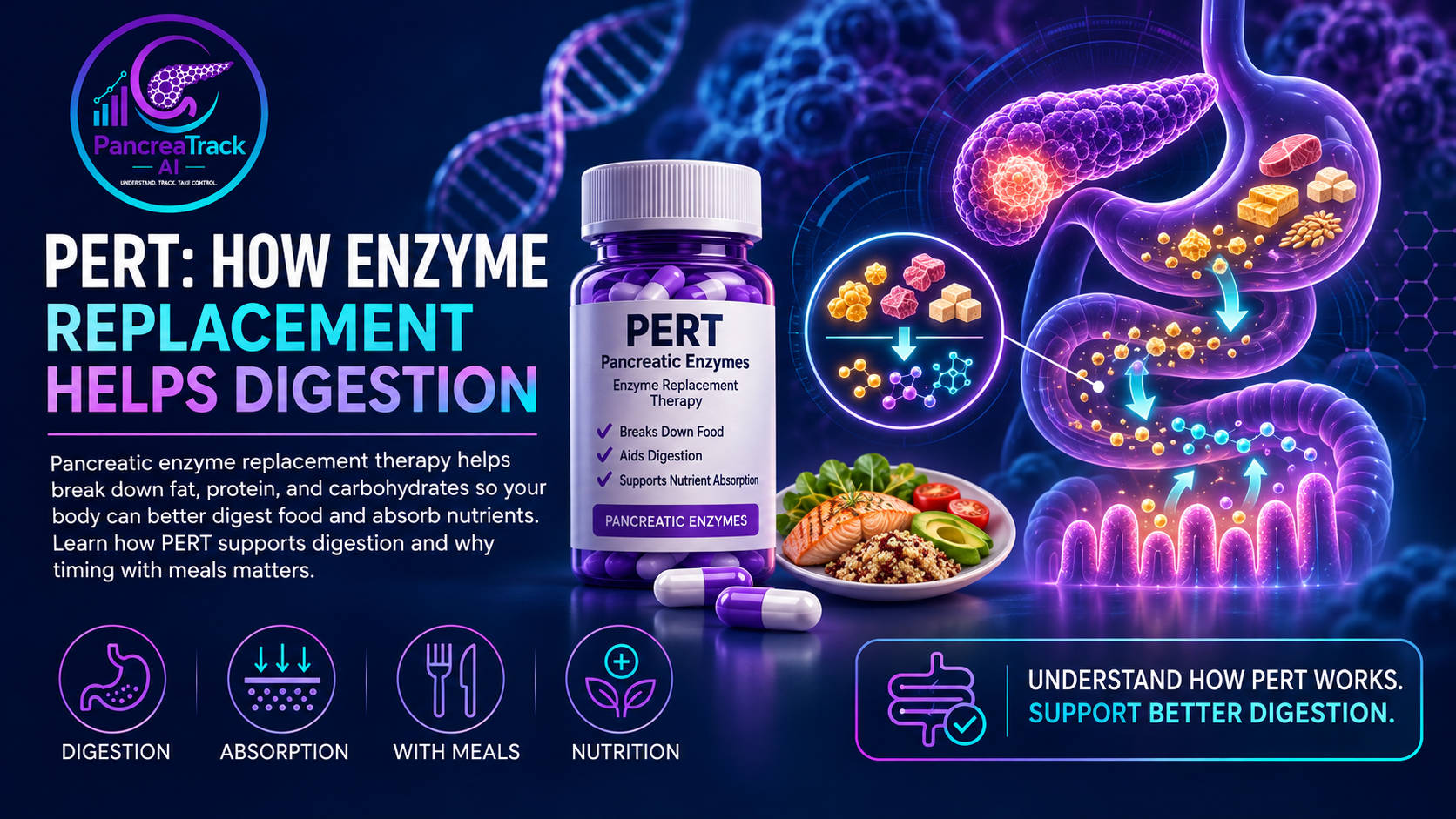
Pancreatic enzyme replacement therapy — PERT — replaces those missing enzymes. It does not repair the pancreas. It does the job the pancreas can no longer do, meal by meal.
How PERT Works
PERT capsules contain the same three enzymes a healthy pancreas makes: lipase, protease, and amylase. You take them with food, so the enzymes mix with the meal as it is digested — which is why timing matters more than most people expect.
The American Gastroenterological Association (AGA) suggests PERT should be started once EPI is diagnosed, with an initial dose of at least 40,000 units of lipase per meal for adults, and half that amount for snacks. The dose is then adjusted based on the size of the meal and its fat content. Your clinician individualises the dose — these are general starting principles, not a prescription.
A few practical points that come up again and again:
- Take it with the meal, not after it. Enzymes need to be present when food arrives. The usual advice is to take them with the first few mouthfuls, or during the meal.
- Split the dose for larger or longer meals. Part at the start, part midway through, so enzymes are available for the whole meal rather than only the beginning.
- Match the dose to the meal. A higher-fat meal generally needs a higher dose than a light snack — which is why a fixed dose for every meal does not always work.
- Take it with every meal and snack that contains fat. Skipping it for a "small" snack still leaves that food undigested.
- Do not take it on an empty stomach. With no food to work on, the enzymes have nothing to digest.
If symptoms persist, clinicians usually check the dose and timing first — sometimes doubling the dose, or adding a medicine that protects the enzymes from stomach acid — before concluding that PERT is not working. That is a conversation for your doctor, not a change to make on your own.
Signs PERT May Be Helping — or Needs Adjusting
PERT is judged by what changes after meals, not by a single blood test. Signs it is helping include:
- less bloating and pain after eating
- stools that are less oily, greasy, or floating, and less urgent
- weight stabilising, or slowly recovering, rather than drifting down
- being able to eat a more normal range of foods without the same aftermath
Signs it may need adjusting — worth raising with your doctor or dietitian — include:
- oily or greasy stools that have not improved
- continued weight loss despite eating well
- bloating or pain that is unchanged after several weeks on PERT
- running out of capsules before the month ends, because the dose does not match how often you eat
None of these on their own proves the dose is wrong. They are the pattern your care team needs to see, over weeks rather than days.
What to Track
Because PERT is about meals, the log that helps is a meal log:
- What you ate, and roughly how much — especially fat content, and whether the meal was large or long
- Enzyme dose and timing — what you took, how much, and whether it was at the start, split through the meal, or after it
- Pain score (1–10) and when it started after eating
- Symptoms after eating — bloating, nausea, oily or greasy stools, urgency
- Weight — a slow downward trend is easy to miss without a record
- Blood sugar readings, if you track them — digestion and blood sugar are linked, and both are affected by the same damaged pancreas
After two or three weeks, that log can show what a single appointment cannot: whether a split dose works better than a single dose, whether larger or fattier meals are the ones that still cause trouble, and whether weight is finally holding steady. That is the evidence a doctor needs to adjust the dose — and the record that stops the conversation being "it still hurts" and starts it being "it hurts after large, fatty meals, even with enzymes at the start."
A Note on Diet
PERT is not a reason to eat a very low-fat diet, and an extremely low-fat diet is not necessary for most people on PERT — it can make nutrition worse. Many people do best on small, frequent meals with a moderate amount of fat, with enzymes matched to each meal. What "moderate" means for you, and whether any foods are still worth limiting, is a question for your doctor or a dietitian, ideally with your log in front of them.
Do not stop PERT, change the dose, or cut whole food groups on the basis of a hunch. Use the log to start a conversation, not to replace one.
When to Call Your Doctor
Get urgent medical care for:
- severe abdominal pain that your usual measures do not touch
- vomiting that will not stop, or being unable to keep fluids down
- fever over 100.4°F (38°C), or shaking chills
- yellowing of the skin or eyes (jaundice)
- a racing heartbeat, dizziness, or confusion
- signs of very low blood sugar that do not lift after treatment, or a low that leaves you confused or unable to help yourself
- pain that is rapidly getting worse instead of plateauing
And get checked soon — not urgently, but do not put it off — if you notice unexplained weight loss, oily stools that do not improve on PERT, or repeated lows. If you are ever unsure, err on the side of being evaluated. The U.S. National Library of Medicine provides an overview of pancreatitis symptoms and complications for patients who want to learn more, and the National Pancreas Foundation offers educational resources on living with pancreatitis and communicating with your care team.
Why Tracking Beats Guessing
PERT only works if it meets the meal — the right dose, at the right time, every time. That is a lot to remember, and a lot to get right by feel alone. A few seconds of logging per meal turns "I think I'm taking them right" into a record your doctor can actually adjust: which meals still cause trouble, whether splitting the dose helped, and whether your weight is finally holding.
At PancreaTrack, we built our tracking tools for exactly that: quick meal, enzyme, pain, and glucose logging that takes seconds on a bad day, and turns into clear trends and doctor-ready summaries when you need them — so the next appointment starts with the whole story, pancreas included.
Sources
- Pancrelipase Therapy — StatPearls, NCBI Bookshelf (American Gastroenterological Association guidance on PERT dosing and timing). https://www.ncbi.nlm.nih.gov/books/NBK534816/
- U.S. National Library of Medicine (MedlinePlus) – Pancreatitis. https://medlineplus.gov/pancreatitis.html
- National Pancreas Foundation – Pancreatitis educational resources.
*⚕️ Medical Disclaimer: PancreaTrack is a health tracking tool designed to help patients log and organize their symptoms — it is not a substitute for professional medical advice, diagnosis, or treatment. Always consult your physician or a qualified healthcare provider if you are experiencing pain, new symptoms, or any change in your condition. Never disregard professional medical advice or delay seeking it because of something you have read on this site.*