The Problem With a Short Appointment
Most doctor appointments last 15 minutes or less. Pancreatitis does not fit into 15 minutes — not when the story involves pain that comes and goes, meals that trigger it, enzymes timed to those meals, blood sugar that rises and falls, and weight that has drifted over months.
So the visit usually goes one of two ways. Either you try to tell the whole story from memory and run out of time halfway through, or you summarise it as "it's been about the same" and the doctor has nothing concrete to work with. Neither is anyone's fault. Memory is a poor record, and a short appointment is a poor format for a long, complicated condition.
A doctor-ready report fixes the format problem. It is not a longer story. It is the same story, organised so a clinician can read it in a minute and act on it.
What a Doctor-Ready Report Actually Contains
A useful report is short, dated, and specific. It answers the questions a doctor will ask, before they have to ask them:
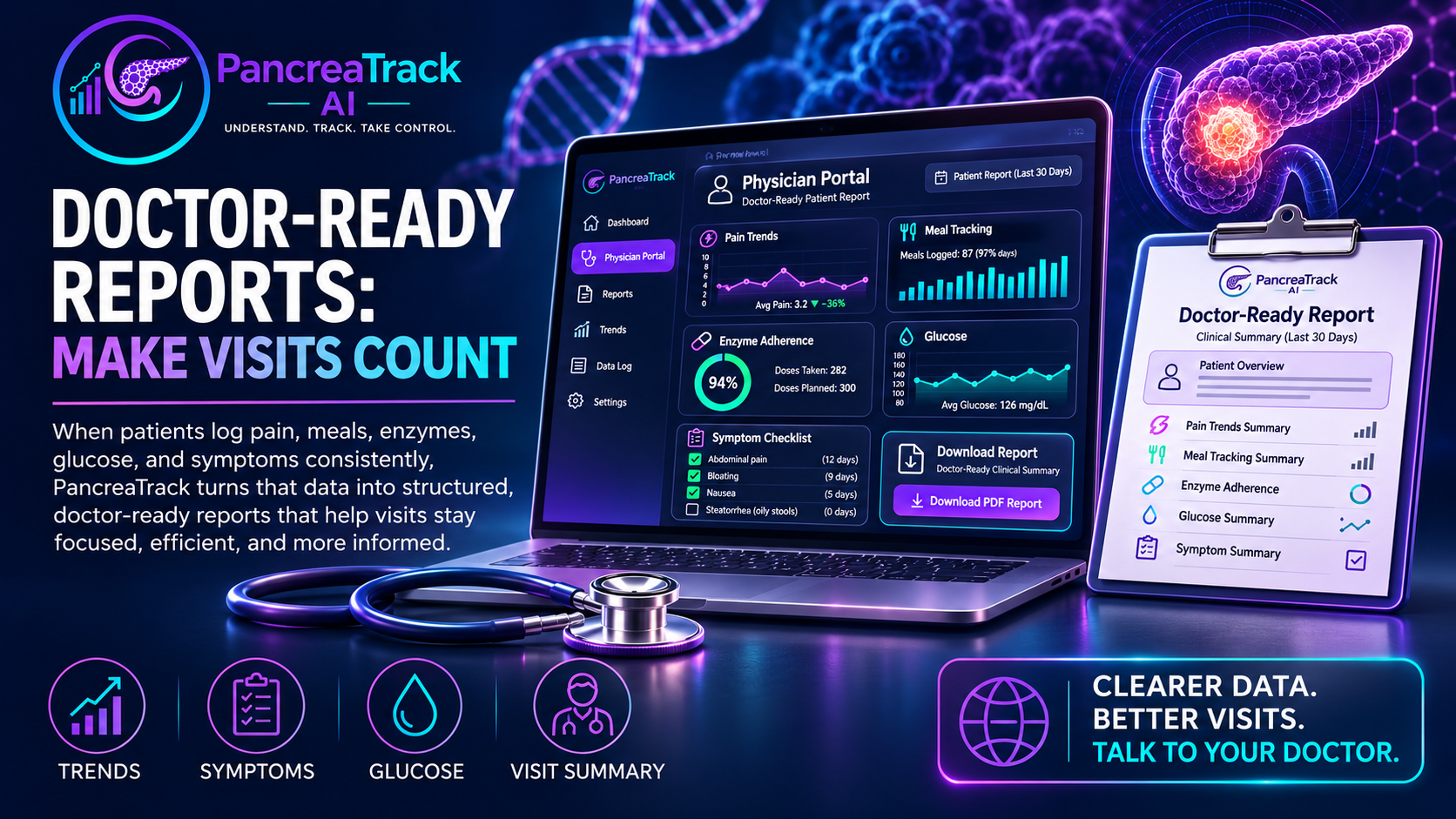
- Pain trends, not single scores — average pain over the last two to four weeks, how often it peaked, and what it was doing when it peaked: after meals, at night, after particular foods
- Meal patterns — which foods or meal sizes repeatedly preceded pain, and which did not, with dates rather than general impressions
- Enzyme timing and doses (PERT) — what you took, when relative to meals, and whether splitting the dose or changing the dose changed anything
- Glucose readings — highs and lows, with times and whether they were before or after a meal, especially if Type 3c diabetes is part of the picture
- Weight trend — a slow drift down over weeks is easy to miss day to day, and it is one of the clearest signs a doctor wants to see
- Questions to ask — written down in advance, so the visit does not end with the question you forgot to ask
What it leaves out matters too. A doctor does not need every meal you ate for a month, or every pain score you ever logged. They need the pattern: what repeats, what changed, and what you want them to decide.
How to Build One From Your Log
You do not need to build a report from scratch the night before an appointment. If you have been logging — even briefly, even imperfectly — the report is already mostly written. The work is selecting, not creating:
- Pick the window. Two to four weeks before the visit is usually enough to show a trend without drowning the doctor in data.
- Look for repeats, not single incidents. One bad night after pizza proves very little. Pizza followed by pain three times out of four is a pattern worth bringing.
- Note what changed. A new medicine, a dose change, a different enzyme timing, a food you cut out — and whether anything improved after it.
- Write down two or three questions. The ones that matter most: "Could this be Type 3c rather than Type 2?" "Should my enzyme dose change?" "Is this weight loss something to worry about?" Put them at the top, not the bottom.
- Bring it on paper or on your phone — and hand it over. A report that stays in your pocket helps no one. Give the doctor something they can keep, refer to, and put in your file.
If you have not been logging, a week of focused logging before the visit is still worth more than a month of trying to remember. Pain, meals, enzymes, glucose, weight — a few seconds per entry, for seven days, is enough to start a real conversation.
What Changes When You Bring One
A report changes the visit in three practical ways:
- It starts where it should. Instead of spending the first ten minutes reconstructing the last month, the doctor starts with the trend and can spend the time on decisions.
- It makes the invisible visible. A slow weight loss, a pattern of lows after missed meals, pain that always follows large fatty meals — these are hard to describe from memory and obvious in a trend.
- It gives the doctor something to act on. "Fatty meals seem to trigger pain" is a guess. A log showing dates, portions, enzyme timing, and pain scores is evidence a care team can work with — and a basis for changing a dose, ordering a test, or referring you on.
It also changes the visit for you. Walking in with a report and three written questions means you leave with answers to the questions that mattered, instead of remembering them in the car park.
When to Call Your Doctor
A report is for a planned visit, not for urgent symptoms. Get urgent medical care for:
- severe abdominal pain that your usual measures do not touch
- vomiting that will not stop, or being unable to keep fluids down
- fever over 100.4°F (38°C), or shaking chills
- yellowing of the skin or eyes (jaundice)
- a racing heartbeat, dizziness, or confusion
- signs of very low blood sugar that do not lift after treatment, or a low that leaves you confused or unable to help yourself
- pain that is rapidly getting worse instead of plateauing
And get checked soon — not urgently, but do not put it off — if you notice unexplained weight loss, repeated lows, or symptoms that are new or worsening. If you are ever unsure, err on the side of being evaluated. The U.S. National Library of Medicine provides an overview of pancreatitis symptoms and complications for patients who want to learn more, and the National Pancreas Foundation offers educational resources on living with pancreatitis and communicating with your care team.
Why This Matters
Pancreatitis is a condition that rewards a good record — and punishes a bad memory. Pain, food, enzymes, glucose, and weight all move together, and no one can hold all of that in their head across weeks and months. A log turns that tangle into a trend. A report turns the trend into a visit that actually moves things forward.
At PancreaTrack, we built our tracking tools for exactly that: quick pain, meal, enzyme, and glucose logging that takes seconds on a bad day, and turns into clear trends and doctor-ready summaries when you need them — so the next appointment starts with the whole story, pancreas included.
Sources
- U.S. National Library of Medicine (MedlinePlus) – Pancreatitis. https://medlineplus.gov/pancreatitis.html
- National Pancreas Foundation – Pancreatitis educational resources.
*⚕️ Medical Disclaimer: PancreaTrack is a health tracking tool designed to help patients log and organize their symptoms — it is not a substitute for professional medical advice, diagnosis, or treatment. Always consult your physician or a qualified healthcare provider if you are experiencing pain, new symptoms, or any change in your condition. Never disregard professional medical advice or delay seeking it because of something you have read on this site.*