The 15-Minute Problem
Your gastroenterologist appointment is 15 minutes long.
Your chronic pancreatitis doesn't take 15 minutes off.
It's with you at 2 a.m. when the pain wakes you up. It's at the dinner table when you can't eat what everyone else is eating. It's at the pharmacy trying to remember if you took your enzymes before the meal or during it.
And then you walk into your doctor's office and they ask: "How have you been feeling?"
And you say "Not great" — because what else can you say? You can't remember which week was the worst. You can't remember what you ate before that flare. You don't know if the new enzyme dose is actually working or if you just had a good week.
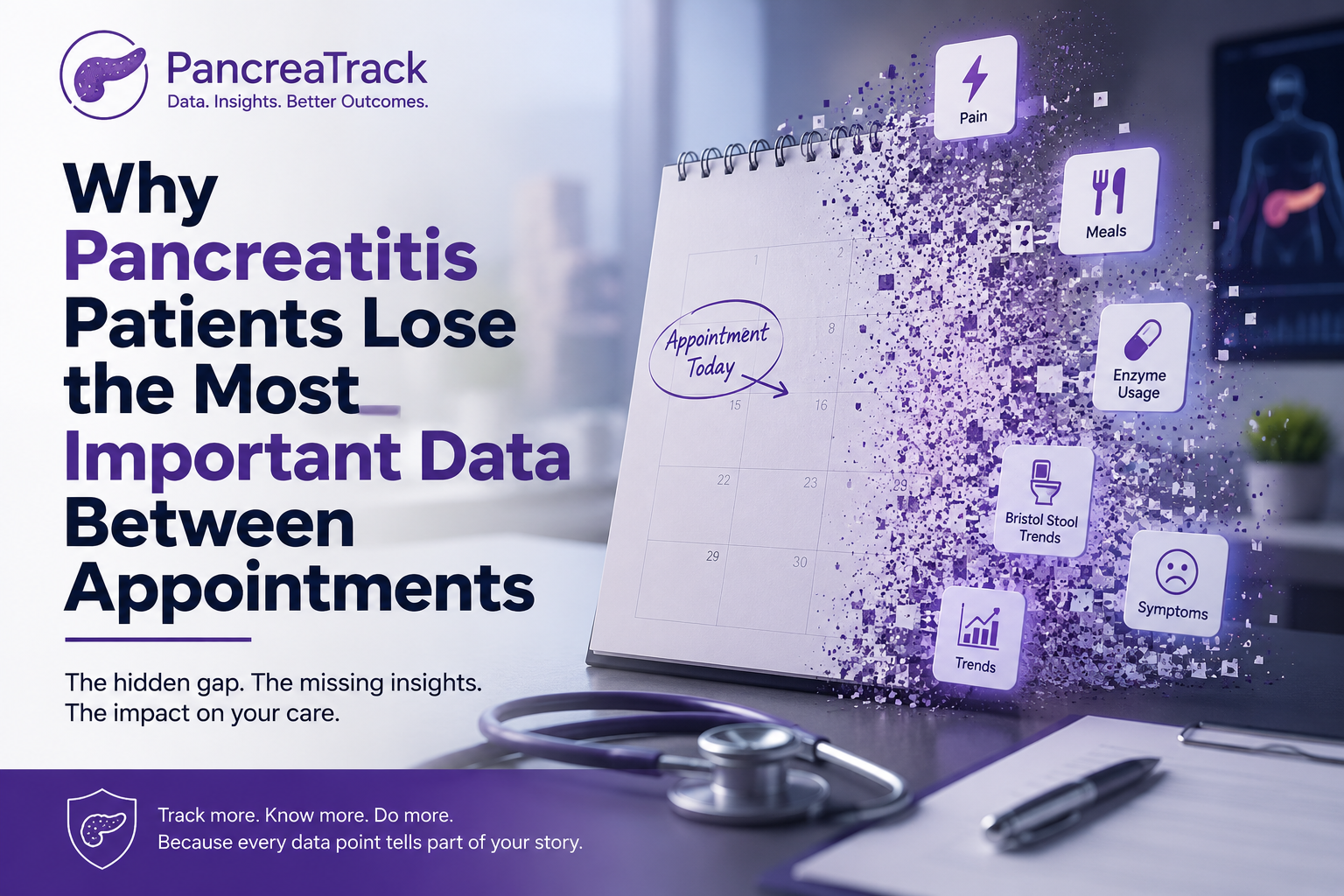
That data existed. You lived it. But it's gone.
What Gets Lost
Chronic pancreatitis and EPI patients deal with a level of daily complexity that most people — including many physicians — don't fully appreciate. On any given day you're managing:
- Pain levels that shift hour to hour
- Enzyme dosing that changes based on fat content in every meal
- Blood sugar fluctuations if you have pancreatogenic diabetes
- Steatorrhea symptoms that indicate enzyme under-dosing
- Fatigue, nausea, and appetite changes that don't fit neatly into any single category
- CGM readings if you're monitoring glucose
- Stress and sleep, which directly trigger flares for many patients
None of this shows up in a lab result. None of it is captured in a clinic note. It exists only in your memory — and memory is a terrible medical record.
The Appointment Gap Is Bigger Than You Think
The average chronic pancreatitis patient sees their gastroenterologist every 3 to 6 months.
Six months is 4,380 hours.
Your 15-minute appointment represents 0.006% of the time your disease was actually active.
Physicians are making treatment decisions — adjusting enzymes, ordering imaging, changing pain management plans — based on a tiny, unrepresentative window. And patients are trying to summarize nearly half a year of daily suffering in the time it takes to drink a cup of coffee.
This isn't a failure of medicine. It's a data problem.
Why This Matters More for Pancreatic Disease
Other chronic conditions have solved parts of this problem. Diabetics have continuous glucose monitors that feed data directly to their care team. Cardiac patients have wearables that track heart rate variability. Even blood pressure patients have home cuffs with apps.
Pancreatic disease patients have been left out of this revolution.
Chronic pancreatitis is already one of the most under-researched, under-funded, and misunderstood conditions in gastroenterology. Add the appointment data gap on top of that and patients go to visits feeling dismissed — not because their doctor doesn't care, but because there's no shared record of what actually happened.
What Tracking Changes
When patients come to appointments with a documented history — even a simple one — the dynamic shifts completely.
Instead of "I've been having pain", it becomes:
"I had 14 high-pain days this month. 11 of them happened within 6 hours of eating. The three that didn't were the weeks I forgot my enzymes twice."
That's actionable. That's a conversation a physician can work with. That's data that changes what gets ordered, what gets adjusted, and how seriously the visit is taken.
Patients who track aren't just better prepared. They're better advocates for themselves.
What PancreaTrack Was Built For
PancreaTrack AI was built specifically for this gap — not as a general wellness app, but as a clinical-grade daily tracking tool for chronic pancreatitis, EPI, and post-TPIAT patients.
Every feature was designed around one question: What data would make your next appointment more productive?
- Daily pain logging with location and severity
- Meal and enzyme tracking linked to symptom outcomes
- Stool and GI symptom logging for EPI monitoring
- CGM integration for glucose tracking
- Flare pattern detection so trends become visible over time
- Appointment-ready reports you can hand to your care team
Your data belongs to you. Your health history belongs to you. And your next appointment should reflect what you've actually been through — not just what you can remember in the moment.
Start Tracking Today
If you're living with chronic pancreatitis or EPI, the most powerful thing you can do before your next appointment is start building a record.
It doesn't have to be perfect. It just has to exist.