Most people living with chronic pancreatitis have heard the same advice: keep a pain journal. Write down when it hurts, how bad it is, what you ate. It sounds simple — almost too simple. So simple that a lot of patients stop doing it after a few days because it feels pointless.
But here's what nobody tells you: that log isn't for you. It's for your doctor. And the difference between a patient who tracks consistently and one who doesn't can mean the difference between a treatment plan that works and years of trial and error.
Let's break down what your physician actually sees when you hand them real pain data.
A Single Pain Score Means Almost Nothing
When your doctor asks "what's your pain been like?" and you say "like a seven," that number lands with almost no clinical weight. A 7 today and a 7 three months ago might be completely different situations — different duration, different triggers, different accompanying symptoms.
A single score is a photograph. A pain log is a film.
What physicians are actually trained to look for is pattern recognition — not individual data points, but the shape of your pain over time. Is it getting worse month over month? Does it consistently spike after certain meals? Does it correlate with your enzyme dosing? Is it waking you up at night more than it used to?
None of that is visible in a snapshot. All of it is visible in a log.
What a Good Pain Log Actually Captures
According to the , chronic pancreatitis pain is one of the most difficult symptoms to manage precisely because it varies so widely between patients. That variability is exactly why consistent, structured tracking matters.
A useful pain log captures more than a number. It captures:
- Time and duration — not just when it started, but how long it lasted
- Severity on a consistent scale — so scores mean the same thing across weeks and months
- Associated symptoms — nausea, vomiting, bloating, back radiation
- What you ate — fat content matters enormously in pancreatitis management
- Medications taken — and whether they helped
- Stress, sleep, and activity — all known contributors to flare frequency
When this data is aggregated over 30, 60, or 90 days, your doctor can start asking questions they couldn't ask before: Why does your pain spike every Friday? What changed in week three of last month? Is your enzyme dose actually working?
The Problem With Paper Logs (And Most Apps)
The traditional approach — a notebook, a spreadsheet, a notes app — creates data that's hard to act on. It's unstructured, inconsistent, and nearly impossible for a physician to review in a 15-minute appointment.
Research published in found that patients using structured digital symptom tracking had measurably better communication with their care teams and reported feeling more in control of their condition. The key word is structured — free-text notes don't give physicians the standardized data points they need to identify trends.
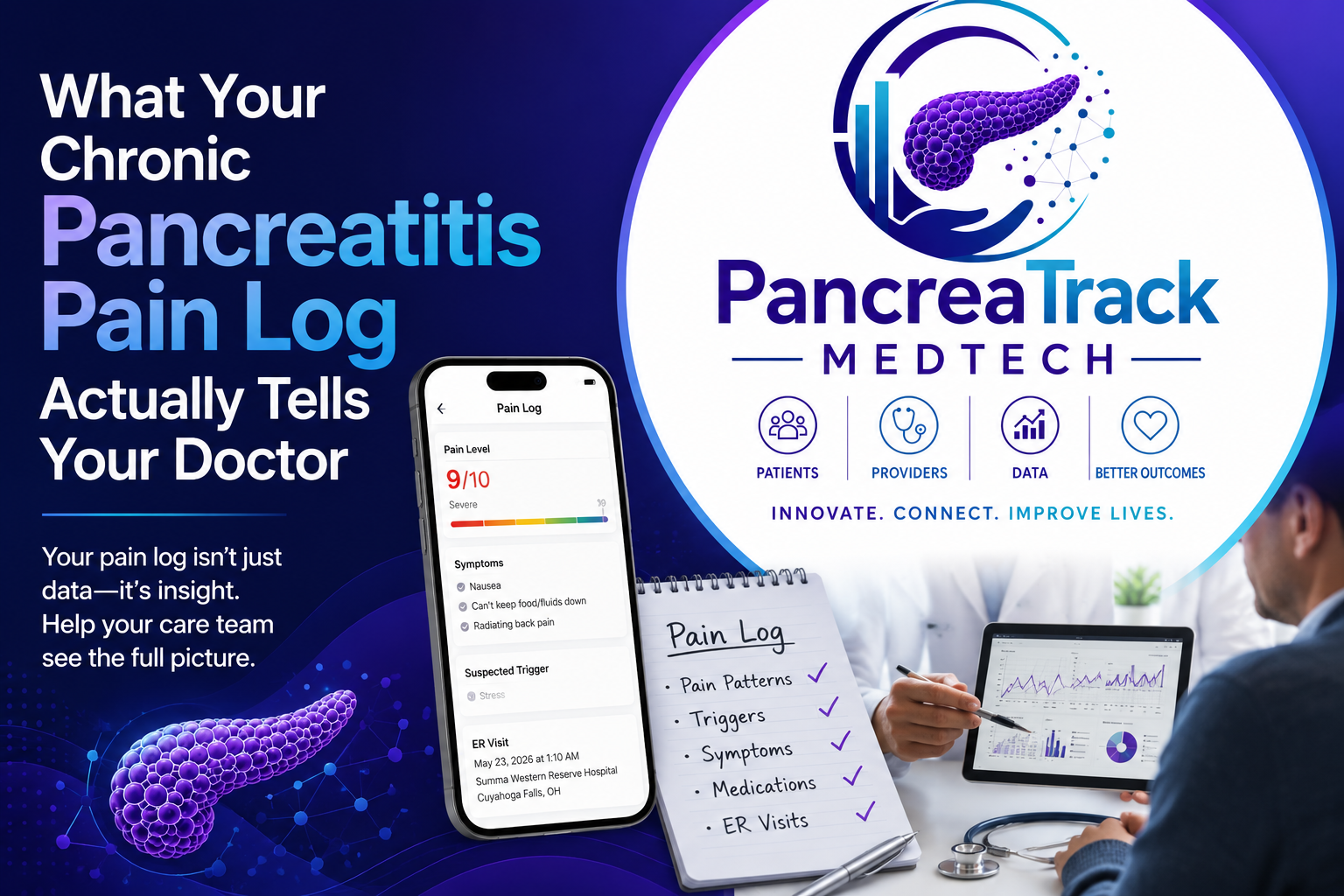
This is exactly the problem was built to solve. Every pain log entry is timestamped, scored on a consistent 1–10 scale, and tied to meal data, enzyme logs, and symptom flags — automatically. When your physician opens your , they don't see a wall of notes. They see a 30-day trend line, a severity breakdown, and a pattern report generated by AI that flags anomalies before they become crises.
What Physicians Do With the Data
When a gastroenterologist or pain specialist reviews structured longitudinal pain data, they're looking for several things:
1. Trend direction. Is your average pain score increasing, decreasing, or plateauing? A slow upward trend over three months is a clinical signal that warrants intervention before a crisis.
2. Trigger correlation. Does your pain reliably follow high-fat meals? Does it spike during periods you've logged as high stress? Identifying these correlations is how physicians refine dietary and lifestyle guidance from generic to personalized.
3. Medication response. If you started a new enzyme dose or pain protocol, does the data show a measurable change in severity or frequency? Without a log, this is guesswork.
4. Flare frequency. The recognizes flare frequency as a key indicator of disease progression in chronic pancreatitis. A physician tracking your flare count over time has a fundamentally different picture of your disease than one relying on your memory in the exam room.
How to Make Your Log as Useful as Possible
Whether you use PancreaTrack or another tool, these habits make your data significantly more valuable to your care team:
- Log at the same time each day, even on good days — zero-pain days are data too
- Don't round your scores — a 6 and an 8 are clinically different, resist the urge to always say 7
- Log meals the same day — waiting until the next day introduces recall bias
- Note when you skip a dose — your physician needs the full picture, not just the good days
- Use the notes field — brief context ("skipped breakfast," "stressful work day") turns data into a story
Your Log Is Your Advocate in the Exam Room
Living with chronic pancreatitis often means fighting to be taken seriously. Pain that fluctuates, symptoms that come and go, and a condition that's invisible from the outside can make it easy for concerns to be minimized.
A well-maintained pain log changes that dynamic. It gives you something concrete to point to — not "I've been hurting a lot lately" but "my average pain has been 6.8 for the last 45 days, up from 4.1 the month before, and it's spiking every time I eat more than 10 grams of fat."
That's not a complaint. That's a clinical case.
Start building yours at — it's free, takes 30 seconds a day, and gives your doctor something they can actually use.
⚕️ Medical Disclaimer: PancreaTrack is a health tracking tool designed to help patients log and organize their symptoms — it is not a substitute for professional medical advice, diagnosis, or treatment. Always consult your physician or a qualified healthcare provider if you are experiencing pain, new symptoms, or any change in your condition. Never disregard professional medical advice or delay seeking it because of something you have read on this site.
Sources
- National Institute of Diabetes and Digestive and Kidney Diseases. Pancreatitis: Symptoms & Causes. U.S. Department of Health and Human Services.
- Meskó, B., et al. Digital health is a cultural transformation of traditional healthcare. npj Digital Medicine, 2019.
- American Pancreatic Association. Chronic Pancreatitis Clinical Guidelines.
- Yadav, D., & Lowenfels, A.B. The Epidemiology of Pancreatitis and Pancreatic Cancer. Gastroenterology, 2013.