If you've been living with chronic pancreatitis, exocrine pancreatic insufficiency (EPI), or have had pancreatic surgery — and you've also been told you have diabetes — there's something important you need to know.
You may not have Type 1 or Type 2 diabetes.
You may have Type 3c diabetes — a distinct, often misdiagnosed, and poorly understood form of diabetes caused directly by damage to the pancreas. And if that's the case, the treatment approach for Type 1 or Type 2 may not be right for you.
Let's break it all down.
What Is Type 3c Diabetes?
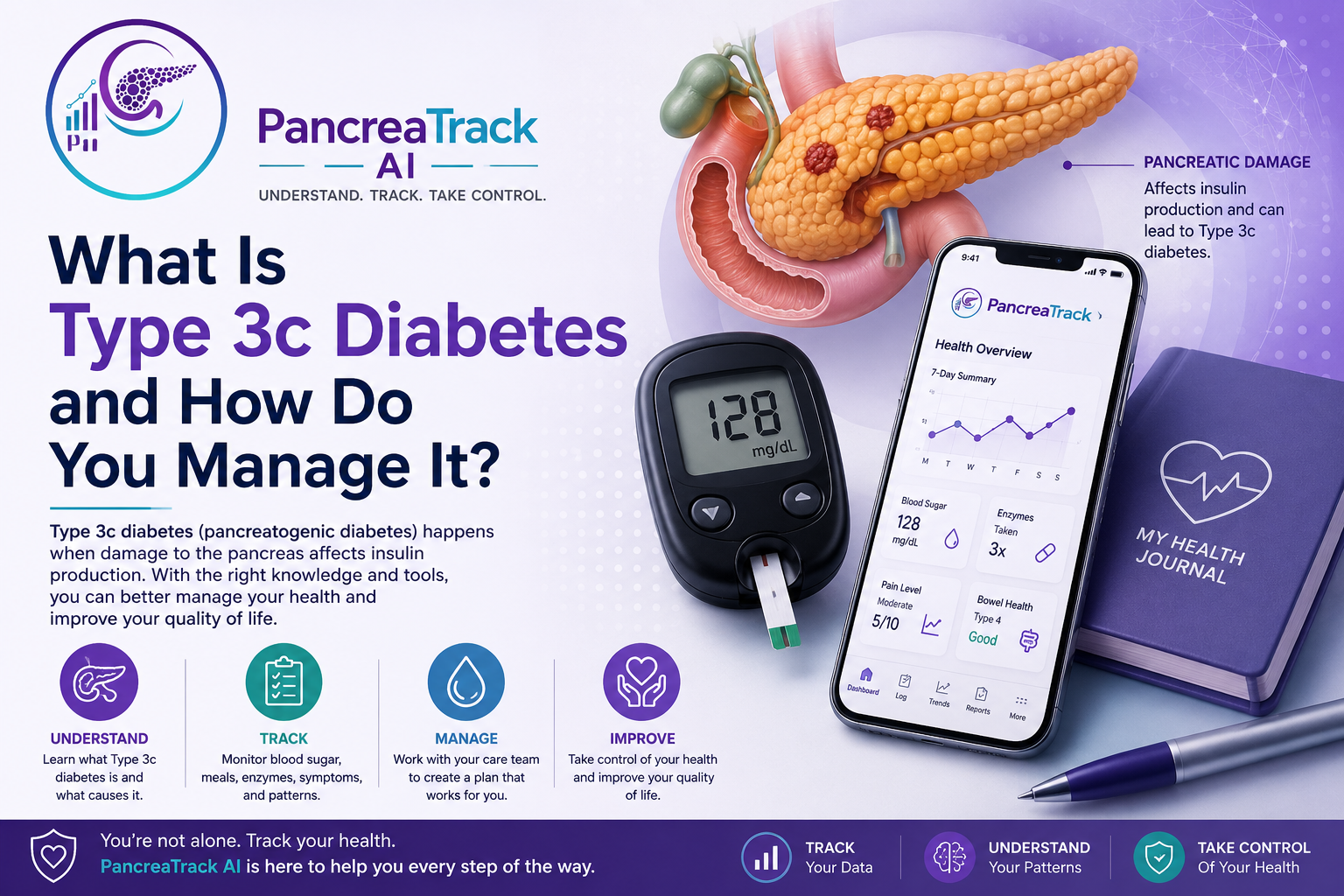
Type 3c diabetes — also called pancreatogenic diabetes or diabetes of the exocrine pancreas — is diabetes that results from disease or damage to the pancreas itself. It's not caused by an autoimmune attack on insulin-producing cells (like Type 1), and it's not caused by insulin resistance driven by lifestyle factors (like Type 2).
Instead, Type 3c develops because the pancreas has been physically damaged — by chronic inflammation, scarring, surgery, or progressive disease — to the point where it can no longer produce enough insulin to regulate blood sugar normally.
The conditions most commonly associated with Type 3c diabetes include:
- Chronic pancreatitis — the most common cause
- Exocrine pancreatic insufficiency (EPI)
- Total pancreatectomy with islet autotransplantation (TPIAT)
- Pancreatic cancer
- Cystic fibrosis
- Hemochromatosis
If you have any of these conditions and are managing elevated blood sugar or a diabetes diagnosis, Type 3c should absolutely be on your radar.
How Common Is Type 3c Diabetes?
More common than most people — including most doctors — realize.
Research estimates that Type 3c diabetes accounts for up to 10% of all diabetes cases in Western countries. Among chronic pancreatitis patients specifically, studies show that 25 to 35% will develop diabetes over the course of their disease.
Despite this, the vast majority of Type 3c patients are never correctly identified. Most are labeled as Type 2, handed a standard diabetes treatment plan, and sent on their way — without anyone connecting the dots back to their pancreatic disease.
How Is Type 3c Different from Type 1 and Type 2?
This is where it gets critical — because the differences aren't just academic. They affect how Type 3c should be treated and what risks the patient faces.
Type 1 diabetes is an autoimmune condition where the immune system destroys the beta cells in the pancreas that produce insulin. The pancreas stops making insulin almost entirely. It has nothing to do with lifestyle and is not related to pancreatic disease.
Type 2 diabetes develops when the body becomes resistant to insulin over time, and the pancreas eventually can't keep up with demand. It's heavily influenced by genetics, weight, and lifestyle.
Type 3c diabetes is different from both. When the pancreas is damaged by disease, it loses both insulin-producing beta cells and glucagon-producing alpha cells. That second part — the glucagon — is what makes Type 3c uniquely dangerous.
Glucagon is the hormone that raises your blood sugar when it drops too low. In healthy people, when blood sugar falls, glucagon kicks in as a rescue mechanism. In Type 3c patients, that rescue system is impaired — which means hypoglycemia (dangerously low blood sugar) can be more severe, harder to detect, and harder to recover from on your own.
Type 3c patients also frequently have co-existing EPI, which adds another layer of complexity. When digestive enzymes aren't working properly, carbohydrates aren't absorbed consistently — making blood sugar even harder to predict.
Why Does Type 3c Get Misdiagnosed So Often?
The short answer: most clinicians aren't trained to look for it.
When an adult presents with elevated blood sugar, the default assumption is almost always Type 2. Standard diabetes bloodwork — HbA1c, fasting glucose — tells you that diabetes is present, but it doesn't tell you why. Without digging into the patient's full pancreatic history, the connection to Type 3c is easy to miss.
There's also a coordination problem. Many pancreatitis patients see a gastroenterologist for their pancreatic disease and an endocrinologist or primary care doctor for their blood sugar — and these specialists often aren't communicating with each other. The dots never get connected.
The result is patients who are misclassified, undertreated, or given medications that aren't appropriate for their actual condition.
Signs and Symptoms of Type 3c Diabetes
Some symptoms overlap with other forms of diabetes:
- Frequent urination
- Increased thirst
- Unexplained weight loss
- Fatigue and low energy
- Blurry vision
- Slow-healing wounds
But there are warning signs more specific to Type 3c:
- Unpredictable blood sugar swings — highs and lows that don't follow an obvious pattern
- Hypoglycemic episodes — shaking, sweating, confusion, or fainting, especially between meals
- Poor blood sugar control despite following treatment as prescribed
- Ongoing weight loss even when eating regularly
- Blood sugar that changes dramatically based on how well your digestion is working that day
How Is Type 3c Diabetes Diagnosed?
There's no single definitive test for Type 3c — which is part of why it's so often missed. Diagnosis typically involves:
- A documented history of pancreatic disease — chronic pancreatitis, EPI, pancreatic surgery, etc.
- Evidence of exocrine pancreatic insufficiency — fecal elastase test, imaging, or clinical history
- Ruling out Type 1 — antibody tests (GAD65, IA-2, ZnT8) to confirm there's no autoimmune component
- Lab work — HbA1c, fasting glucose, C-peptide levels to assess remaining insulin production
If you have pancreatic disease and have been diagnosed with Type 2 diabetes without any of the above being evaluated, it may be worth asking your doctor specifically about Type 3c.
How Do You Manage Type 3c Diabetes?
Managing Type 3c requires a different approach than Type 1 or Type 2. Here's what the evidence and clinical experience support:
1. Treat the Underlying Pancreatic Disease First
Blood sugar control in Type 3c is directly tied to how well your pancreatic disease is managed. Uncontrolled EPI leads to inconsistent nutrient absorption and unpredictable glucose levels. Getting your enzyme therapy right isn't just about digestion — it's a diabetes management strategy.
2. Take Your Enzymes — Every Meal, Every Time
If you have co-existing EPI, consistent PERT (pancreatic enzyme replacement therapy) is non-negotiable for glucose stability. Skipping enzymes doesn't just hurt your digestion — it makes your blood sugar harder to control and increases your hypoglycemia risk.
3. Eat Small, Low-Fat, Moderate-Carb Meals
Large meals — especially high in fat or carbohydrates — are harder on the pancreas and create larger glucose spikes. Eating smaller amounts more frequently throughout the day gives your compromised system a much better chance of keeping up.
4. Work With Your Doctor on the Right Medication
Metformin alone is often not appropriate for Type 3c. It targets insulin resistance, which isn't the primary problem in pancreatogenic diabetes. In malnourished or underweight patients, it can also carry additional risks. Many Type 3c patients require insulin therapy — sometimes at lower doses than Type 1, but insulin nonetheless. Talk to your endocrinologist specifically about Type 3c protocols.
5. Use Continuous Glucose Monitoring (CGM)
Because Type 3c blood sugar is more unstable and hypoglycemia risk is elevated, a CGM is especially valuable. Seeing your glucose in real time — and catching drops before they become dangerous — is a game-changer for Type 3c patients. Tools like Dexcom give you data that self-monitoring with finger sticks simply can't provide.
6. Track Everything — Symptoms, Meals, Enzymes, and Glucose Together
Type 3c doesn't exist in isolation. Your blood sugar is affected by what you eat, whether you took your enzymes, how much pain you're in, and how your digestion is working. Managing it in silos — separate apps for food, glucose, and symptoms — gives you an incomplete picture.
How PancreaTrack Helps Patients with Type 3c Diabetes
PancreaTrack was built for patients who are managing chronic pancreatitis and its downstream effects — including Type 3c diabetes. Unlike general health apps, PancreaTrack connects the dots that matter:
- Log meals with fat and carb content to see how food choices affect both pain and blood sugar
- Track enzyme dosing with every meal to build a consistent PERT habit and monitor effectiveness
- Log lab values including HbA1c and glucose alongside your pancreatic markers — all in one place
- Generate appointment summaries that include your full metabolic picture for your endocrinologist and GI doctor
- CGM integration coming soon via our partnership with Glooko — bringing your continuous glucose data directly into PancreaTrack
If you've been diagnosed with Type 3c — or suspect you might have it — PancreaTrack gives you the tools to understand your patterns, communicate with your care team, and take control of a condition that far too many patients are navigating alone.
The Bottom Line
Type 3c diabetes is real, it's common among pancreatitis patients, and it's almost certainly underdiagnosed. If you have pancreatic disease and are managing blood sugar problems, don't assume you have Type 2. Ask the question. Push for the evaluation.
And if you're already managing Type 3c — know that the right approach looks different from standard diabetes care. Small meals, consistent enzymes, appropriate medication, continuous glucose monitoring, and a platform that tracks it all together are your best tools.
You're not managing one condition. You're managing two — and they're deeply connected. Your care plan should be too.
PancreaTrack AI is a health tracking platform built specifically for chronic pancreatitis and related pancreatic conditions. and start tracking what matters.