The Best Pancreatitis Tracker Apps in 2026 (And What to Actually Look For)
If you have chronic pancreatitis, you already know the drill. You wait weeks for an appointment, you sit down across from your gastroenterologist or pancreatic specialist, and they ask: "How have you been feeling since we last spoke?"
And your mind goes blank. Or you say something vague like, "Pretty bad, I had a few rough weeks in there." But you can't remember exactly when the flares hit, what you ate beforehand, how your pain scored that Tuesday at 2 a.m., whether the new enzyme dose actually helped, or whether your stool changes correlated with that one meal you thought was safe.
You leave the appointment without the answers you needed, and your doctor makes decisions based on incomplete information. It's not anyone's fault — it's a systems problem. And the solution is a pancreatitis tracker that actually understands your disease.
But here's the honest truth: most apps that claim to help with chronic illness tracking were not built with pancreatitis in mind. They don't know what steatorrhea is. They've never heard of PERT. They treat your pancreatic enzyme replacement dose the same way they'd treat a vitamin C supplement. That's not good enough.
In this guide, we reviewed every meaningful pancreatitis tracking app available in 2026 — from hospital-built clinical tools to patient-built apps to general symptom trackers — so you can make an informed decision about which tool is actually worth your time. We'll be honest about the limitations of every option, including our own.
Why Tracking Matters So Much for Chronic Pancreatitis
Chronic pancreatitis is one of the most difficult chronic conditions to manage, not just because of the pain, but because of how variable and invisible so much of the disease is. A flare can be triggered by something as subtle as a slightly higher-fat meal, a period of stress, a medication change, or seemingly nothing at all. Exocrine pancreatic insufficiency (EPI) compounds this — poor fat absorption can cause symptoms that are easy to attribute to the wrong thing if you're not tracking carefully.
Research consistently shows that patients who actively track symptoms between appointments have better outcomes. They can identify food triggers more accurately, communicate more effectively with their care teams, and catch early warning signs of complications before they escalate. For post-surgical patients — particularly those who have undergone a total pancreatectomy with islet autotransplant (TPIAT) — tracking is even more essential, because managing insulin-producing islet cells on top of enzyme replacement creates a level of complexity that almost demands a dedicated tool.
And yet, the tools available have not kept pace with the clinical complexity of this disease. Until recently, your options were a paper journal, a generic symptom app, or nothing at all.
What a Real Pancreatitis Tracker Needs to Do
Before we compare the apps, it's worth establishing what a legitimate chronic pancreatitis tracking app should actually be capable of. These are the questions your pancreatic specialist would want answered at every appointment.
1. Disease-Specific Symptom Logging
Generic symptom trackers ask you to rate pain on a scale of 1–10. A real pancreatitis tracker needs to capture where the pain is (epigastric, radiating to the back), what type it is (sharp, dull, burning), what triggered it, how long it lasted, and whether it correlated with eating. These are clinically distinct data points that change the conversation with your doctor.
2. EPI and Enzyme Dose Tracking
Exocrine pancreatic insufficiency affects the majority of people with chronic pancreatitis to some degree. Managing it requires adjusting pancreatic enzyme replacement therapy (PERT) based on meal fat content, symptoms, and stool changes. A real EPI tracker should let you log your enzyme doses per meal, track steatorrhea symptoms, and correlate that data over time. If an app doesn't have this, it is not a complete pancreatitis management tool.
3. Food and Diet Logging with Context
Not just "what did you eat" but how much fat was in it, did symptoms follow, and how long after the meal. Low-fat diet compliance is a cornerstone of pancreatitis management, and the only way to know if it's working is to track both the input (the meal) and the output (the symptom response).
4. Lab Result Tracking
Lipase levels, liver enzymes, HbA1c for those managing post-TPIAT diabetes, triglycerides for those whose pancreatitis is HTG-induced — these numbers tell a story over time that single snapshots can't. A real pancreatitis tracking app should give you a place to store and visualize lab trends.
5. Physician Data Sharing
The whole point of tracking is to improve the quality of your medical appointments. If your data lives in a silo that only you can see, it's only half as useful as it could be. A good pancreatitis tracker should have a mechanism for sharing organized data with your care team — whether that's a physician portal, a shareable report, or an export function.
6. Flare Pattern Recognition
One of the most powerful things tracking can do is help you see patterns that aren't obvious in the moment. Is your pain worse after certain foods? Does it spike after travel? Is your enzyme dose consistently insufficient on weekends when your diet is less controlled? Pattern recognition over time is what separates reactive management from proactive management.
The Pancreatitis Tracker Apps We Reviewed in 2026
We evaluated every meaningful option currently available — from hospital-built tools to independent patient apps to general-purpose symptom trackers. Here's what we found.
P.A.N.C.R.E.A.S. App
The P.A.N.C.R.E.A.S. app is a genuinely heartening thing to see. It was built by William Crittenden, a pancreatitis patient himself, which means it comes from a place of authentic understanding rather than clinical abstraction. The app's virtual assistant, named Crea (short for Panacea), provides a conversational interface for daily care plans based on how you're feeling — a thoughtful design choice for patients who don't always have the energy to fill out lengthy forms during a flare.
Platform: iOS only | Cost: Free | Last updated: October 2024
What we liked: It's free, it's disease-specific, and the AI assistant approach is genuinely innovative for this space. The fact that a patient built it means the emotional design is more empathetic than most clinical tools. For newly diagnosed patients trying to understand their disease, it's a meaningful starting point.
What it lacks: There is no EPI-specific tracking, no enzyme dose logging, no lab result storage, and no physician data sharing. The tracking depth is relatively basic, and being iOS-only excludes Android users entirely. Because it's maintained by a single independent developer, update consistency can't be guaranteed.
Best for: iOS users in the early stages of their diagnosis who want a compassionate, conversational tool and aren't yet managing complex EPI or post-surgical care.
SmartCP App
SmartCP was developed by the clinical team at Tallaght University Hospital in Ireland, funded through government healthcare research channels. From a clinical design standpoint, it's impressive. It includes daily symptom logging, a diet and physical activity log, a red-flag alert system for worsening symptoms, monthly check-ins for diabetes and pancreatic cancer screening, and a secure messaging function that connects patients directly to their clinical team.
Platform: Mobile (iOS/Android) | Cost: Not publicly available | Developed: 2022
What we liked: The red-flag alert system is a standout feature that every pancreatitis tracking app should have. The direct clinical team messaging is exactly the kind of bridge between patient data and physician care that chronic pancreatitis management needs. It's evidence-based and built by people who specialize in this disease.
What it lacks: SmartCP is not available to you unless you are a patient at Tallaght University Hospital in Ireland. It is not in any public app store. For patients in the United States, Canada, Australia, or anywhere else in the world, SmartCP is completely inaccessible. There is also no EPI-specific tracking.
Best for: Patients currently under the care of Tallaght University Hospital in Ireland — and only those patients.
My Chronic Pancreatitis App (University Hospitals of Leicester)
This app was developed by University Hospitals of Leicester NHS Trust in the UK. Rather than focusing on daily symptom tracking, it positions itself as an educational resource. The app includes information on managing symptoms and a library of podcasts featuring consultant HPB surgeons, dietitians, pain specialists, clinical psychologists, and diabetes specialist nurses.
Platform: iOS only | Cost: Free
What we liked: The podcast content from genuine pancreatic disease specialists is a meaningful resource, particularly for patients who have just been diagnosed and are trying to make sense of what's happening to their body. Hearing a pain specialist address the psychological burden of chronic pancreatitis can be genuinely valuable.
What it lacks: It is not a pancreatitis tracker in any meaningful functional sense. There is no symptom logging, no data history, no EPI tracking, no food logging, no physician sharing, and no pattern recognition. It is an educational app that happens to be about pancreatitis — and it's only relevant to patients within the UK NHS system.
Best for: Newly diagnosed patients in the UK who want to learn about their condition from credible clinical voices.
General Symptom Trackers (Bearable, Flaredown, Human Health, and Others)
There is a category of well-designed general-purpose chronic illness tracking apps worth acknowledging. Apps like Bearable and Flaredown are thoughtfully built, flexible, and genuinely helpful for many chronic conditions. They allow you to define your own symptoms, log medications, and identify patterns over time.
What we liked: Available to everyone, often free or low-cost, and customizable enough that a determined patient can build something functional.
What they lack: They know nothing about pancreatitis. They don't understand that steatorrhea is a specific and clinically important symptom. They have no concept of PERT dosing, exocrine function, or flare patterns specific to this disease. Using a general tracker for pancreatitis is like using a general fitness app to manage Type 1 diabetes — technically possible, but the tool is constantly working against you.
Best for: Patients who can't find a disease-specific tool and are comfortable building their own symptom tracking framework from scratch.
ADAPT — Ariel Dynamic Acute Pancreatitis Tracker (UPMC)
ADAPT occasionally comes up in searches for pancreatitis tracking tools, so it's worth a brief mention. ADAPT was developed by UPMC as a clinician-facing tool for tracking acute pancreatitis severity scoring in hospital settings. It is used by medical teams — not patients. It is not publicly available, it does nothing for chronic pancreatitis management between appointments, and it was never designed for patient use. We mention it only to save you the time of investigating a tool that isn't for you.
Comparison at a Glance
| Tool | Publicly Available | Disease-Specific | EPI Tracking | Physician Sharing | Platform |
|---|---|---|---|---|---|
| PancreaTrack AI | Yes | Yes (CP + EPI + TPIAT) | Yes | Yes | Web (any device) |
| P.A.N.C.R.E.A.S. | Yes | Yes (basic) | No | No | iOS only |
| SmartCP | No (hospital only) | Yes | No | Yes (messaging) | Mobile |
| Leicester App | Partial (UK NHS) | Educational only | No | No | iOS only |
| General Trackers | Yes | No | No | No | Varies |
| ADAPT (UPMC) | No (clinicians only) | Acute only | No | N/A | Clinical system |
PancreaTrack AI: Built by a Patient, for Patients
PancreaTrack was founded by Timothy Lunsford, who did not come to chronic pancreatitis through medical school or a research grant. He came through a ventilator. Through dialysis. Through pseudocysts and necrotized pancreatic tissue and an attempted total pancreatectomy with islet autotransplant surgery that had to be stopped after seven hours on the table. He built this tool because the tools he needed didn't exist when he needed them most.
That origin matters — not as a marketing point, but because it's the reason PancreaTrack tracks the things other apps don't. It's why the enzyme dose logging is granular enough to actually matter. It's why there's a specific field for steatorrhea. It's why the physician portal exists — because Timothy knows exactly what it feels like to walk into a specialist appointment without data and feel invisible.
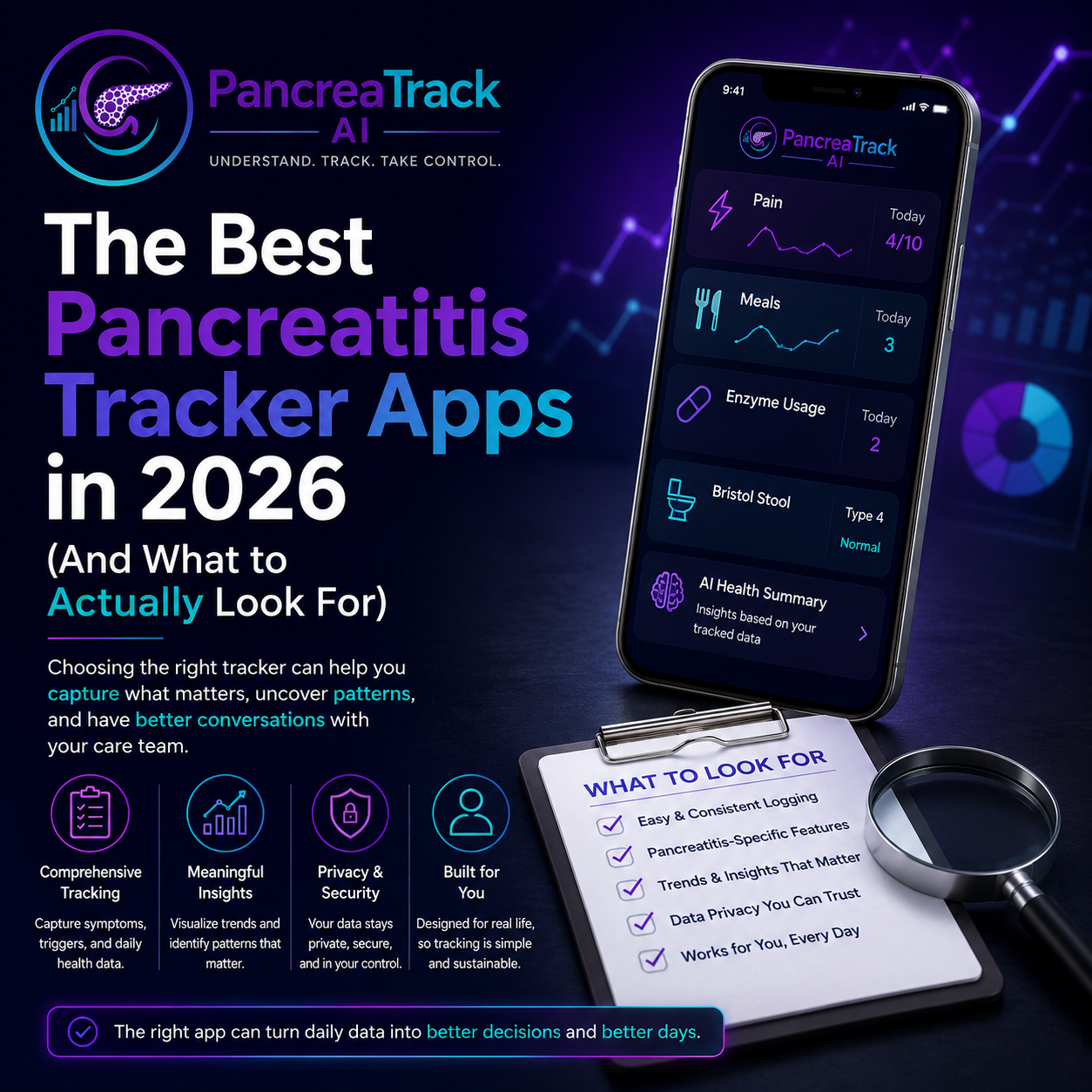
What PancreaTrack Actually Tracks:
- Symptom logging — pain location, pain type, severity, duration, and correlation with meals or activity
- PERT (enzyme replacement) dose tracking — log doses per meal, track response, identify whether your current regimen is working
- Food and diet logging — with fat content context to correlate dietary choices with symptom flares
- Steatorrhea and EPI symptom tracking — the dedicated EPI tracker component that no other publicly available app offers
- Lab result storage — lipase, liver enzymes, triglycerides, HbA1c, and more
- Flare pattern recognition — AI-powered analysis of your logged data to surface patterns you might not see on your own
- Physician portal — your doctor can log in and view your data directly, making every appointment more productive
- Post-TPIAT support — specific tracking for patients managing life after total pancreatectomy
Honest Limitations:
PancreaTrack is currently web-based. There is no native iOS or Android app yet — that is on the development roadmap, but it's not here today. If you need an app with push notifications that lives on your home screen, you'll be accessing PancreaTrack through your mobile browser for now. It is also a newer platform, which means it's still growing. The feature set expands regularly, but it doesn't yet have years of user data behind it the way an established app might.
We say this plainly because you deserve accurate expectations. What PancreaTrack is right now — today — is the most complete, disease-specific pancreatitis tracker available to any patient, anywhere, on any device with a browser.
How to Choose the Right Pancreatitis Tracker for You
The right chronic pancreatitis tracking app depends on where you are in your disease journey.
If you were recently diagnosed and are still learning: Start with something that doesn't overwhelm you. The Leicester app has good educational content. P.A.N.C.R.E.A.S. offers a gentler introduction to daily tracking. But plan to graduate to a more comprehensive tool — you'll quickly outgrow basic tracking as your needs become clearer.
If you have EPI and are managing enzyme replacement therapy: You need a dedicated EPI tracker. PERT dosing is nuanced, and if your tracker can't capture the connection between meal fat content, enzyme dose, and subsequent symptoms, you're missing the most important feedback loop in your daily management. PancreaTrack is currently the only publicly available tool with dedicated EPI tracking built in.
If you have complex care involving multiple specialists: Physician data sharing is non-negotiable. You need a tool that lets your gastroenterologist, endocrinologist, and pain specialist all see the same data. PancreaTrack's physician portal is designed for exactly this multi-provider context.
If you've had or are considering TPIAT surgery: Post-TPIAT management is unlike anything else in chronic pancreatitis care. You're managing the intersection of exocrine insufficiency, islet cell function, post-surgical recovery, and significant emotional complexity. A generic symptom tracker is not equipped for this.
If you are outside the United States: SmartCP and the Leicester app were built for specific UK and Irish NHS patients. If you're anywhere else in the world, your options narrow considerably — which makes a web-based tool like PancreaTrack particularly valuable, since it's accessible from any country on any device.
The Bottom Line on Pancreatitis Tracking in 2026
The state of pancreatitis tracking tools is better than it was five years ago, but it's still far behind where patients need it to be. There are genuinely good people — patients, clinicians, researchers — building tools for this community with real compassion. P.A.N.C.R.E.A.S. represents what patient-built technology can be. SmartCP represents what clinically-funded technology can be. Both are meaningful contributions.
But the gap between what exists and what chronic pancreatitis patients actually need — a comprehensive, disease-specific, EPI-aware, physician-connected pancreatitis tracker available to anyone, anywhere — has not been filled by any hospital-built or general-purpose tool currently on the market.
That gap is what PancreaTrack AI was built to fill.
If you've spent years going to appointments with vague answers, managing your enzyme doses by guesswork, or wondering whether your steatorrhea is getting better or worse — you deserve a tool that takes all of that seriously. Not a generic symptom log. Not a podcast library. A real, intelligent, disease-specific chronic pancreatitis tracking app that works the way your disease actually works.
The best time to start tracking was at your diagnosis. The second best time is today.
Try PancreaTrack AI free at pancreatrack.com — no app store required, no credit card, no waiting. Just start tracking in a way that finally makes sense for chronic pancreatitis.
PancreaTrack AI is not a medical device and does not provide medical advice. All tracking data should be reviewed with your licensed healthcare provider. If you are experiencing a severe flare or symptoms of acute pancreatitis, seek emergency medical care immediately.