Most people have never heard of hypertriglyceridemia. Their doctors might not bring it up at the ER. The standard blood panel might not even catch it. And yet, for thousands of pancreatitis patients, dangerously high triglycerides were the cause of their attack all along — quietly waiting to be discovered.
This is the story of HTG-induced pancreatitis. And if you've had recurring pancreatitis with no clear explanation, it may be your story too.
What Is HTG and Why Does It Matter for Pancreatitis Patients?
Hypertriglyceridemia — or HTG — simply means your triglyceride levels are abnormally high. Triglycerides are a type of fat found in your blood. Your body uses them for energy, but when they build up to extreme levels, they become dangerous. Very dangerous.
Under normal circumstances, triglyceride levels should be below 150 mg/dL. Borderline high is 150–199. High is 200–499. Very high is 500 and above.
But in HTG-induced pancreatitis, we're not talking about slightly elevated numbers. We're talking about levels that can climb into the thousands — sometimes above 1,000, 2,000, even 10,000 mg/dL and beyond. At those concentrations, the fatty acids in your blood essentially become toxic to your pancreas, triggering severe inflammation that can lead to necrotizing pancreatitis, organ failure, and life-threatening complications.
After alcohol and gallstones, hypertriglyceridemia is the third leading cause of acute pancreatitis — responsible for anywhere from 5% to 22% of all cases depending on the population studied. During pregnancy, it becomes the leading cause, accounting for up to 50% of pancreatitis episodes.
That's not a rare edge case. That's a significant portion of pancreatitis patients who may have a cause that was never properly identified.
The Diagnostic Blind Spot Nobody Talks About
Here's where it gets alarming — and where the medical system is quietly failing pancreatitis patients.
When you come into the emergency room with abdominal pain, the standard workup for pancreatitis includes checking your serum amylase and lipase levels. If they're elevated — typically three times the upper limit of normal — that confirms pancreatitis. This is textbook medicine.
Except when it isn't.
In patients with severely elevated triglycerides, the high fat content in the blood can actually interfere with standard laboratory testing. The result? Falsely normal or even falsely low amylase and lipase readings — even when the pancreas is actively inflamed and under attack.
Research has confirmed that serum amylase levels can appear completely normal in patients with triglyceride levels ranging from 500 to 6,000 mg/dL. At those levels, the lipemic serum literally distorts the test results. The pancreas is on fire, and the blood test says everything looks fine.
This means a patient can walk into an ER with severe pancreatitis caused by extreme hypertriglyceridemia and be sent home — or misdiagnosed — because the standard markers didn't trigger an alarm. The triglycerides were never checked. The connection was never made.
In these cases, the diagnosis may actually depend on CT imaging of the pancreas rather than blood markers alone. And unless the treating physician specifically orders a triglyceride panel and considers HTG as a cause, it can be completely missed.
The Risk Thresholds That Matter
Not all elevated triglycerides carry the same risk. Here's what the research tells us:
- Above 500 mg/dL: Risk of acute pancreatitis begins to increase significantly
- Above 1,000 mg/dL: Approximately 5% risk of acute pancreatitis
- Above 2,000 mg/dL: Risk climbs to 10–20%
- Above 5,000 mg/dL: Severe and potentially life-threatening pancreatitis territory
In a systematic review of over 1,100 patients with confirmed HTG-induced pancreatitis, the mean triglyceride level at the time of their attack was 3,467 mg/dL. That's not a rounding error. That's blood that looks like milk.
For context, when PancreaTrack founder Timothy Lunsford was hospitalized in December 2024 with what would become one of the most severe pancreatitis cases of his life, his triglycerides exceeded 10,000 mg/dL. He was placed on a ventilator. He required dialysis. He developed pseudocysts and necrotized pancreatic tissue. It took months to begin recovering — and years of prior pancreatitis episodes had never flagged HTG as the underlying driver.
That's not an outlier experience. That's what happens when this condition goes unrecognized.
Who Is at Risk for HTG-Induced Pancreatitis?
Hypertriglyceridemia doesn't appear from nowhere. Certain conditions and lifestyle factors make extreme triglyceride elevation far more likely:
- Type 2 diabetes — poorly controlled blood sugar significantly elevates triglycerides
- Familial hypertriglyceridemia — a genetic condition causing chronically elevated levels
- Hypothyroidism — thyroid dysfunction affects fat metabolism
- Alcohol use — alcohol dramatically raises triglyceride levels
- Certain medications — including some beta-blockers, diuretics, corticosteroids, and antiretrovirals
- High-fat, high-sugar diet — dietary patterns that promote fat storage in the blood
- Pregnancy — hormonal changes significantly affect triglyceride metabolism
- Obesity — particularly metabolic syndrome
If you have one or more of these risk factors and have experienced pancreatitis with no confirmed cause — or with what was labeled "idiopathic" pancreatitis (meaning they couldn't find the reason) — HTG deserves a serious look.
How HTG-Induced Pancreatitis Is Treated
Because the underlying cause is extreme fat in the blood, treatment is focused on rapidly lowering triglyceride levels while managing the pancreatitis itself.
There are two primary approaches:
Insulin drip: Intravenous insulin therapy activates lipoprotein lipase, an enzyme that breaks down triglycerides in the bloodstream. Even in patients who are not diabetic, an insulin drip is used to aggressively lower triglyceride levels during an acute HTG pancreatitis attack. This remains the most common first-line treatment.
Plasmapheresis: In severe cases — particularly when triglycerides are extremely high or when the patient isn't responding to insulin — plasmapheresis (also called plasma exchange) may be used. This process physically filters the triglycerides out of the blood. Studies show plasmapheresis achieves an average triglyceride reduction of 59%, compared to 27% with conservative treatment alone. For life-threatening cases, this speed matters enormously.
In many severe cases, both approaches are used together.
Long-term management then focuses on addressing the underlying cause — controlling diabetes, correcting thyroid dysfunction, dietary changes, triglyceride-lowering medications like fibrates or omega-3 fatty acids, and alcohol cessation if relevant.
What Patients Need to Know — And Ask For
If you have pancreatitis — especially recurring pancreatitis with no confirmed cause — here are the questions worth bringing to your next appointment:
"Has my triglyceride level ever been checked during a flare?" Many patients have their triglycerides checked only on routine metabolic panels, not specifically during acute episodes. A fasting triglyceride panel is standard, but it may not reflect what's happening during a high-fat meal or during stress.
"Could my amylase and lipase have been falsely low because of high triglycerides?" This is a sophisticated question that will signal to your provider that you've done your research — and it may open a conversation that changes the trajectory of your care.
"Should I be tested for familial hypertriglyceridemia?" If your triglycerides are consistently elevated despite dietary changes, a genetic component may be at play. A referral to a lipid specialist or an endocrinologist may be warranted.
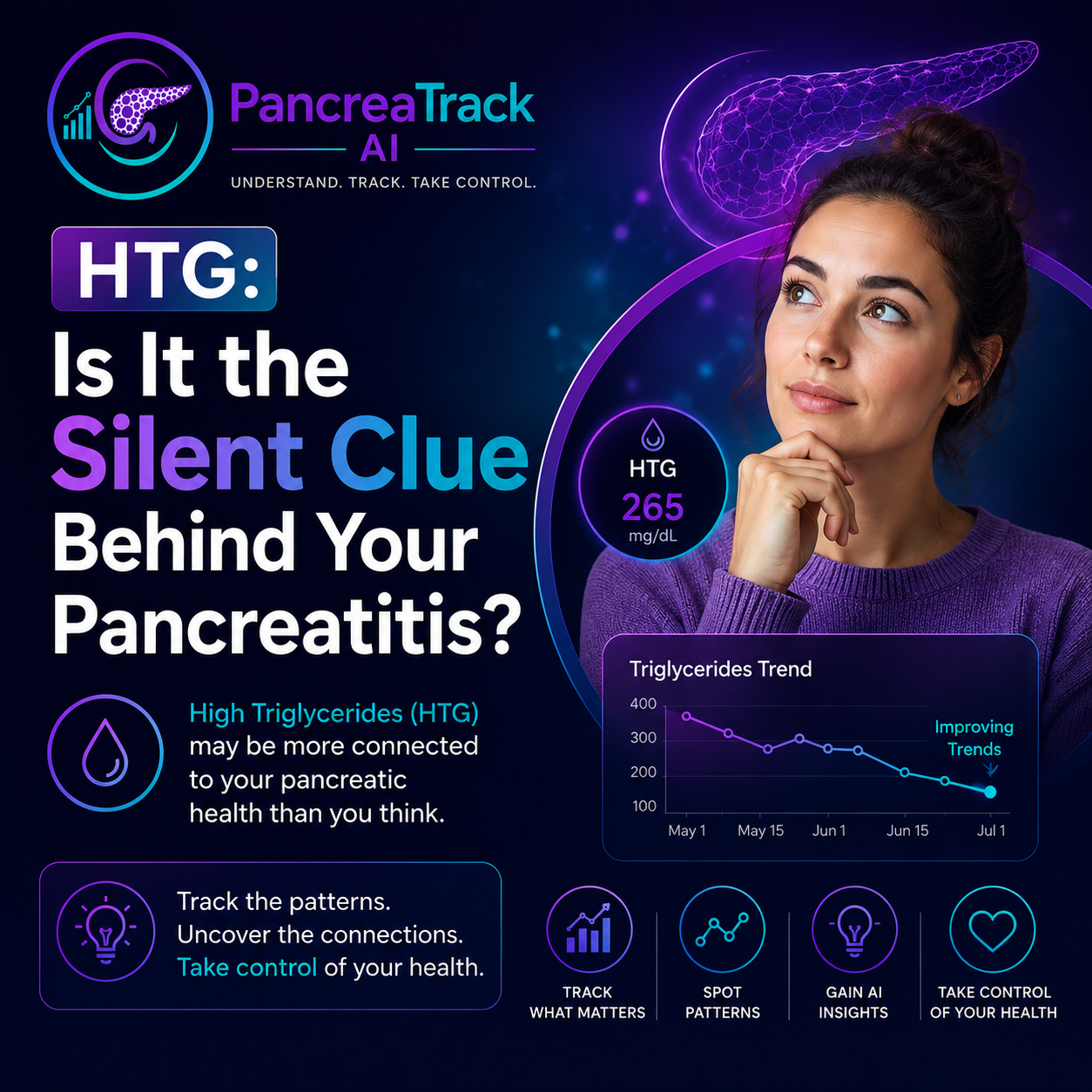
"Should I be tracking my triglyceride levels between appointments?" The answer is almost certainly yes. Understanding your triglyceride trend over time — not just a single snapshot — gives you and your doctor far more useful information.
Tracking HTG Alongside Your Pancreatitis
This is exactly the kind of data that gets lost between appointments. You have a bad week, your symptoms spike, and by the time you see your gastroenterologist the moment has passed. No one ordered a triglyceride level during the flare. The connection never gets made.
PancreaTrack was built specifically to close this gap. You can log lab results — including triglyceride levels — over time, track them alongside your symptom history, and bring a clear, organized picture to every appointment. If your triglycerides tend to spike before a flare, that pattern will show up in your data. If they're consistently elevated, your doctor can see the trend rather than a single number.
For patients managing HTG-induced pancreatitis, tracking isn't optional. It's how you stay ahead of the next attack.
Start tracking at pancreatrack.com — free, no app download required, built specifically for chronic pancreatitis patients.
The Bottom Line
Hypertriglyceridemia-induced pancreatitis is underdiagnosed, underestimated, and often invisible to standard testing. The very lab markers doctors rely on to diagnose pancreatitis can be falsely normal when extreme fat levels in the blood distort the results. Patients go home undiagnosed. Attacks recur. The cause is never found.
If you have pancreatitis and no one has ever talked to you about your triglycerides, it's time to ask. HTG may be the silent clue that changes everything.
PancreaTrack AI is not a medical device and does not provide medical advice. Always consult your licensed healthcare provider about your symptoms, lab results, and treatment options. If you are experiencing symptoms of acute pancreatitis, seek emergency medical care immediately.