You leave your gastroenterologist's office with a follow-up scheduled for three months from now. Maybe six. You walk out the door and that countdown starts — and somewhere in those 90 to 180 days, your pancreas is going to do what it does. There will be bad weeks and better weeks. Flares and recoveries. Meals that wrecked you and meals you somehow survived. Enzyme adjustments made by feel. Nights where the pain was a 9 and mornings where you wondered if yesterday was even real.
And then you'll sit back down in that exam room and your doctor will ask: "How have you been feeling?"
If you're honest, you'll say something like "pretty rough" or "okay, I guess." You'll remember the worst flare because it landed you in the ER. You'll probably forget the week before that when things were actually improving. You won't mention the pattern you didn't notice — that every time you ate more than 20 grams of fat without adjusting your enzymes, the next morning was brutal. Nobody told you to track that. Nobody told you it was clinically useful. And now it's gone, lost somewhere in the fog of three months of living with a chronic illness.
This is the gap. And it's costing you.
The Memory Problem Is Real — and It's Not Your Fault
Researchers who study how patients recall symptoms have a term for what happens over time: recall bias. But "bias" makes it sound like a character flaw. It's not. It's just how human memory works.
When you've had a hundred bad days, your brain stops filing them individually. It starts grouping them, averaging them, flattening the peaks and valleys into something more manageable. Studies on patients with chronic conditions show that people tend to remember the most intense recent experiences and anchor their overall sense of "how I've been" to those, rather than giving an accurate account of the full period. A terrible flare two weeks before your appointment will color your entire three-month report. A string of genuinely better weeks in month two will barely register.
For someone with chronic pancreatitis, this matters enormously. Your physician is trying to understand whether a medication change helped, whether your enzyme dose is working, whether your diet modifications are actually reducing your symptom burden. If the data they're working with is a rough emotional impression filtered through three months of memory compression, the clinical picture they're seeing isn't the real one.
This isn't a criticism of patients. It's a structural problem in how chronic disease management works — appointments are the main channel for clinical information, and appointments happen rarely. The information that accumulates between them mostly disappears.
What Your Doctor Actually Needs
Chronic pancreatitis is one of the most data-intensive conditions to manage well. Pain frequency, severity, and character. Fat intake and enzyme dosing — and critically, the timing between them. Bowel changes that signal malabsorption. Lab trends over time: lipase, HbA1c if you've developed type 3c diabetes, fat-soluble vitamins that often quietly tank when exocrine function fails.
None of this is visible in a single clinic visit. A snapshot lab draw tells you where things stand today. But what your physician often needs to know is: what happened in the 90 days before today? What changed? What pattern is emerging?
Patient-generated health data — the term researchers use for symptoms and behaviors logged by patients in their own daily lives — has been shown in clinical studies to meaningfully improve physician decision-making for chronic conditions. When doctors have access to longitudinal symptom data collected between visits, they catch trends earlier, adjust treatments more precisely, and spend less appointment time on reconstructing history and more time on actually helping.
For pancreatitis specifically, the correlations that matter most — fat intake vs. pain, enzyme dose vs. bowel outcomes, glucose patterns in type 3c diabetes — can only be seen across time. They're invisible in a single visit. They require a record.
The Three-Month Blind Spot
Here's what the gap looks like in practice.
You have a 15-minute appointment. Your physician has 10 other patients that afternoon. They pull up your chart, see your last lipase level, ask about your symptoms. You give them your best reconstruction of the past three months. They adjust your medication, order new labs, and schedule the next visit.
What didn't make it into that conversation: the week you ran out of enzymes and noticed what uncontrolled EPI actually feels like. The meals that reliably spike your pain and the ones that don't. The fact that your stool has been improving but your energy hasn't. The anxiety that's building because you don't know if what you're experiencing is normal progression or something that needs attention now.
Your physician doesn't know these things because no one built a system to capture them. The gap between your appointments is a clinical blind spot — and for patients with progressive, complex disease, that blind spot has consequences.
What Changes When You Track
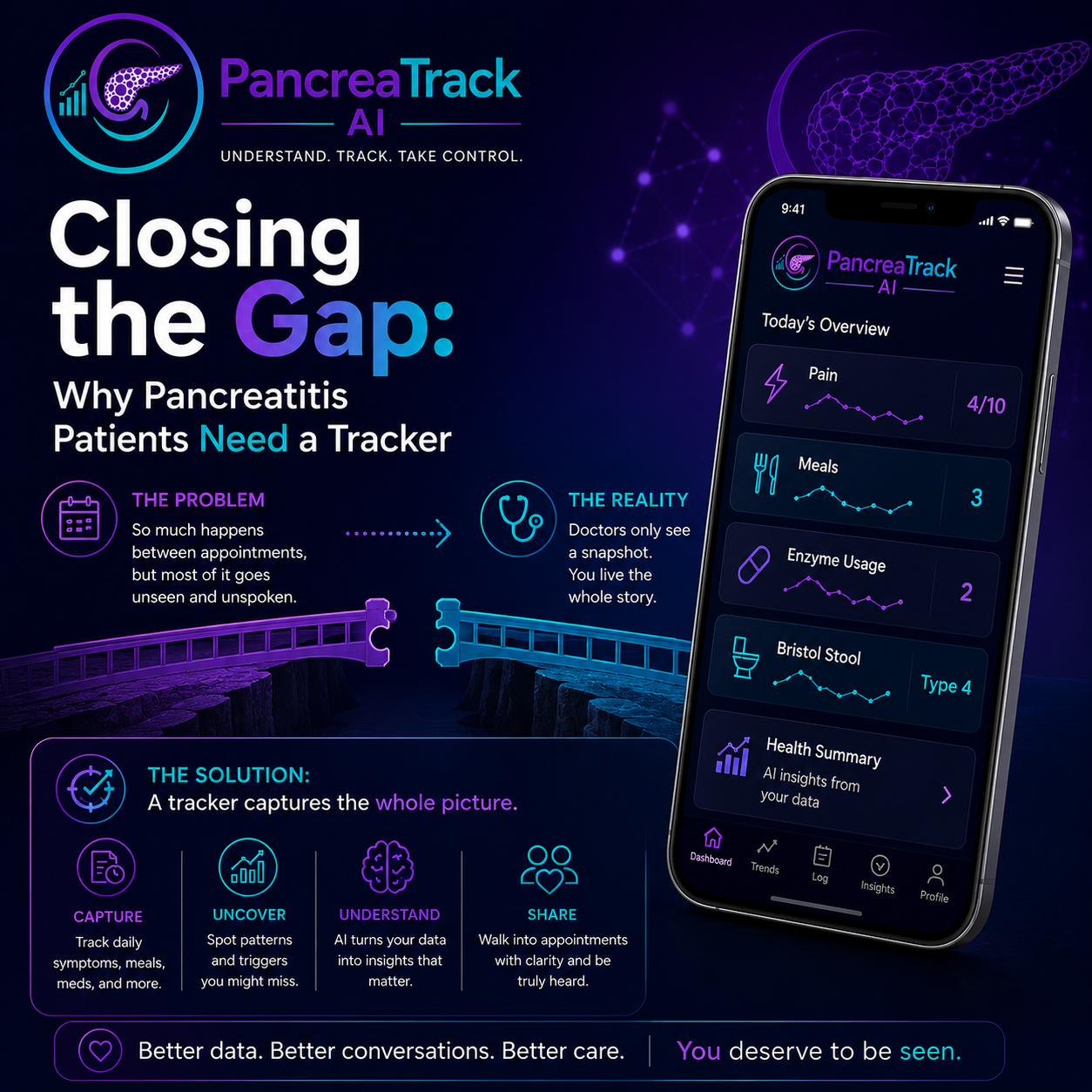
When patients with chronic pancreatitis track consistently — pain scores, meals, enzyme doses, bowel patterns, labs — something shifts in the clinic encounter.
The visit stops being a memory test and starts being a data review.
Instead of "how have you been," the conversation becomes: "I can see you had eight days above a 7 on your pain scale in the past 30 days, and six of them followed meals with over 25 grams of fat. Your enzyme logs show you were taking the same dose regardless of meal size. Let's talk about that."
That's a different appointment. That's an appointment where something actually changes.
Physicians who have access to longitudinal patient data report being able to make treatment adjustments they couldn't have made otherwise — not because they're better doctors, but because they have better information. Enzyme dose adjustments for exocrine pancreatic insufficiency, for example, should be calibrated to fat intake. But without a record of what patients are actually eating and what they're actually taking, adjustments are made largely by patient report and clinical intuition. Data doesn't replace intuition — but it gives it something real to work with.
For patients managing type 3c diabetes alongside pancreatitis, the stakes are even higher. Type 3c behaves differently from Type 1 and Type 2. It's brittle. It's driven by a destroyed pancreas that can no longer regulate insulin or glucagon reliably. Standard diabetes management tools weren't designed for it. Continuous glucose patterns alongside enzyme dosing and fat intake creates a clinical picture no standard diabetes app was ever built to show.
The Compound Effect of Consistent Logging
One logged day tells you very little. One logged week, a bit more. Three months of consistent daily logs — pain, meals, enzymes, bowel, labs — starts to show you things you couldn't have seen any other way.
Patterns you didn't know existed. Triggers you'd written off as random. Correlations between your diet and your outcomes that are genuinely surprising. Most patients who start tracking with any consistency report that they start seeing their own disease differently. Not because the disease changed, but because they finally have enough data to understand it.
This isn't just emotionally useful. It's clinically useful. And it changes the power dynamic of the patient-physician relationship in a way that matters. You stop being the person describing symptoms in the vague, incomplete terms that memory allows. You become the person who walks in with 90 days of data, ready to have a real conversation.
The Gap Doesn't Have to Be Blind
Chronic pancreatitis is relentless. It affects roughly 120 to 143 people per 100,000 — a number that's almost certainly undercounted because it takes an average of several years to get a diagnosis. Up to 87% of patients develop exocrine pancreatic insufficiency over the course of their disease. Many develop type 3c diabetes. A significant portion will eventually be evaluated for surgical options including the total pancreatectomy with islet autotransplantation.
These patients deserve care that's informed by real data, not compressed memory. They deserve appointments where their physician already knows the story — not because they spent 10 minutes trying to tell it, but because the data was captured, organized, and ready to review.
The three-month gap between appointments is not going away. But it doesn't have to be a blind spot.
Track. Show up with data. Change the conversation.
PancreaTrack AI is not a medical device and does not provide medical advice. Always consult your licensed healthcare provider about your symptoms, lab results, and treatment options. If you are experiencing symptoms of acute pancreatitis, seek emergency medical care immediately.