The Numbers Are Hard to Ignore
Something significant is happening in medicine right now.
As of 2026, 75% of U.S. health systems are using at least one AI application in clinical care — up from 59% just one year ago. The FDA has authorized over 1,451 AI-enabled medical devices. The global AI healthcare market hit $21.66 billion in 2025 and is projected to reach $110 billion by 2030.
But statistics don't tell patients anything about what matters most: will this help me?
For people living with chronic pancreatitis, EPI, or post-TPIAT, that question isn't abstract. You've lived through diagnostic delays, conflicting treatment advice, and appointments that felt too short to capture how complex your reality actually is.
AI won't fix all of that overnight. But what's happening right now in medical research is genuinely worth paying attention to — especially if your pancreas is involved.
AI Is Already Working in the GI Space
The most mature clinical AI application in gastroenterology isn't a futuristic concept. It's already in colonoscopy suites.
AI-assisted colonoscopy systems have been validated in multiple randomized controlled trials. One large multicenter study found AI raised polyp detection rates from 56.92% to 67.18%. A 2025 systematic review found AI colonoscopy sensitivity at 95.19% — compared to 77.53% for standard colonoscopy.
Two FDA-cleared commercial systems — EndoScreener and SKOUT — are already deployed in clinical settings, catching flat and diminutive polyps that the human eye frequently misses.
Beyond colonoscopy, AI is being applied to Barrett's esophagus detection, early gastric cancer screening, and inflammatory bowel disease activity scoring. The GI field is moving faster than most patients realize.
The Finding That Should Stop Every Pancreatitis Patient Cold
In early 2025, Mayo Clinic published results from an AI model that can detect pancreatic cancer on routine abdominal CT scans up to three years before clinical diagnosis.
Three years.
The AI identifies subtle texture changes in pancreatic tissue — changes invisible to the human eye — before any tumor is detectable by standard radiology. This matters enormously because pancreatic cancer survival is directly tied to how early it's caught. The five-year survival rate is currently 13% overall. Catch it while still confined to the pancreas and that jumps to 44%. Catch tumors smaller than 2 cm and survival rates approach 80%.
For chronic pancreatitis patients — who carry an elevated lifetime risk of developing pancreatic cancer — this isn't a distant medical curiosity. It's a technology that could save your life.
The REDMOD model behind this research is currently in active clinical trials (NCT06638866). The Lancet Oncology's PANORAMA study confirmed AI substantially outperforms average radiologist performance on standard CT pancreatic cancer detection.
This is real. This is now.
AI Is Learning to Understand Pancreatitis Specifically
The research isn't just happening around pancreatic cancer. AI is being applied directly to pancreatitis diagnosis and management.
Autoimmune pancreatitis (AIP) — one of the most frequently misdiagnosed conditions in gastroenterology, often confused with pancreatic cancer — is a specific target. A 2025 study showed an AI model achieving 91% accuracy in diagnosing pancreatic cancer while also achieving 73% sensitivity in distinguishing AIP from malignancy. An active clinical trial (NCT06369909) is testing an AI-assisted multimodal diagnosis system specifically for autoimmune pancreatitis.
Acute pancreatitis severity prediction is another active area. Machine learning models using LightGBM and XGBoost have been integrated directly into hospital information systems to predict in real time: sepsis risk, ICU admission likelihood, and mortality in pancreatitis patients. That's not a research paper — that's live clinical decision support.
Chronic pancreatitis pain is perhaps the most personal application. Machine learning models are now being developed to predict individual patient response to pregabalin — one of the most commonly prescribed pain medications for chronic pancreatitis — based on personal characteristics. The goal is to know before prescribing which dose will work for you specifically, and minimize the side effects that come with trial-and-error.
The Rare Disease Connection
Chronic pancreatitis patients know the diagnostic odyssey better than almost anyone. The average rare disease patient waits 4 to 6 years from first symptoms to accurate diagnosis.
AI is actively attacking that problem.
zebraMD, an AI algorithm now embedded in EHRs at UCLA, UCSF, and Dartmouth Health, recognized 71% of rare disease patients earlier than their actual diagnosis — saving an average of 1.2 years of diagnostic delay per patient.
The International Rare Diseases Research Consortium has set a 2027 goal: diagnose all known rare diseases within one year of first seeking medical advice. ARPA-H's RAPID program is funding AI-driven tools specifically to shrink the diagnostic gap from years to months.
For a disease like chronic pancreatitis — which is frequently dismissed as "just alcohol-related" or misdiagnosed for years — these tools represent something patients have needed for a long time: a system that takes the full picture seriously.
What Tracking Has to Do With All of This
Here's something that doesn't get said enough: AI needs data to work.
The breakthroughs happening in pancreatic disease AI — early cancer detection, severity prediction, personalized pain management — are built on patient data. Imaging data, lab data, clinical data, and increasingly, patient-reported outcomes: what you ate, how much pain you had, how your enzymes worked, how you slept.
Patients who track their symptoms, meals, enzyme doses, and glucose levels aren't just helping themselves at their next appointment. They're contributing to the data foundation that will train better pancreatic disease AI.
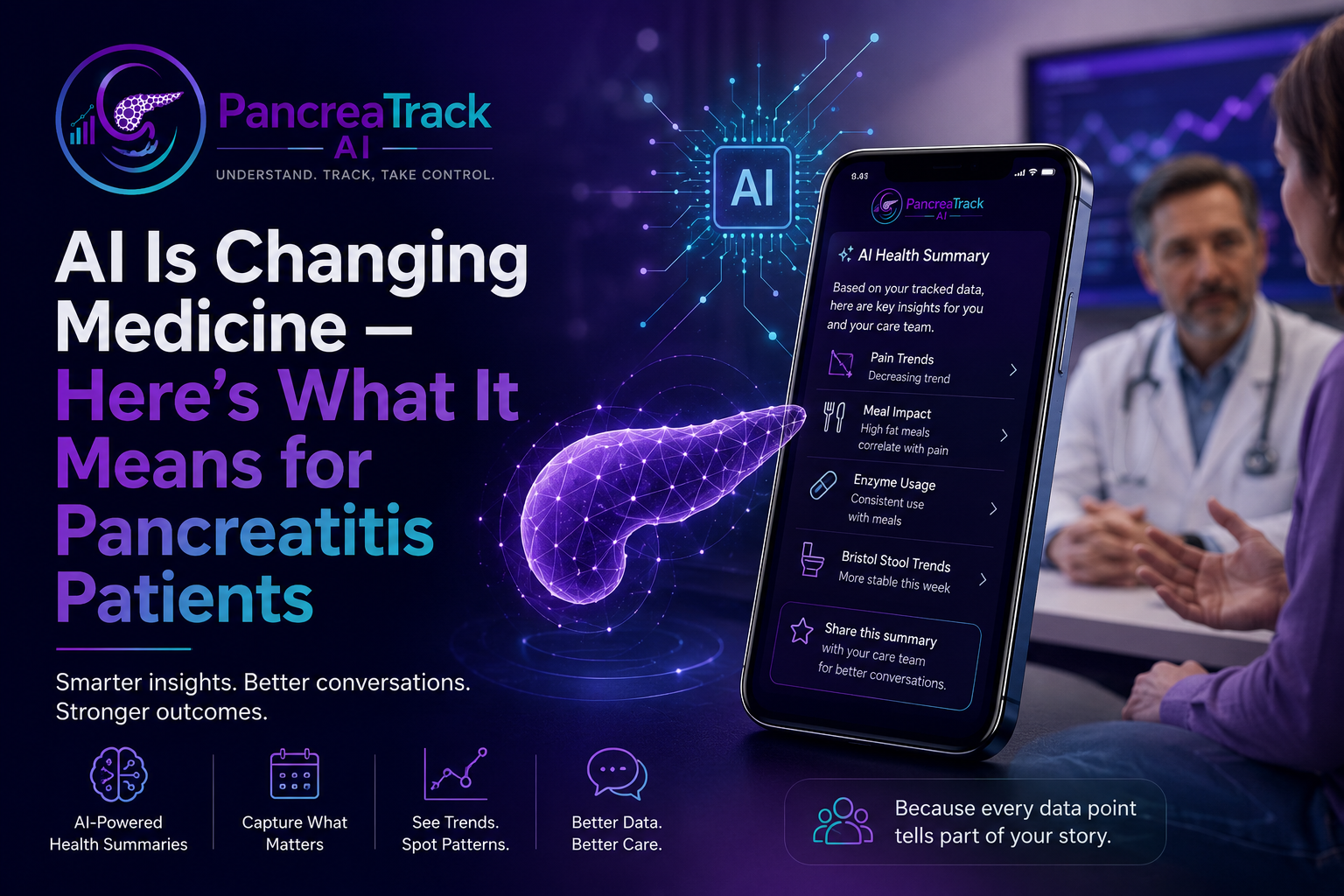
Every log entry in PancreaTrack is a data point. Pain level after a high-fat meal. Enzyme effectiveness across different food types. Glucose response after a flare. These are exactly the kinds of longitudinal, patient-reported data points that researchers need — and that patients living with chronic illness are uniquely positioned to provide.
Your daily tracking has value beyond your next GI appointment. It has the potential to contribute to research that helps the next person diagnosed after you.
The Honest Caveat
AI in medicine is real and accelerating — but it isn't perfect, and it isn't equally distributed.
A 2024 review found that 73% of clinical AI training data came from the Americas and Europe — regions representing only 22% of the global population. Models trained on narrow datasets can perform worse — or dangerously — for underrepresented groups. A postpartum depression AI model was documented to produce lower diagnosis rates for Black women. These aren't theoretical risks.
Fewer than 20% of healthcare institutions report sustained, high-success AI use in core clinical diagnosis. Broad adoption is happening. Deep, proven, equitable integration is still being built.
The regulatory framework is catching up. The FDA published its first comprehensive AI device lifecycle guidance in January 2025. International regulators joined in August 2025 to establish shared principles for AI medical devices.
AI in medicine is not hype. But it also isn't finished. The right posture is informed optimism — understanding what's real, what's coming, and what still needs work.
What This Means for You Right Now
If you're living with chronic pancreatitis or EPI, here's the practical takeaway:
Ask your GI team whether AI-assisted tools are being used in their practice — particularly for endoscopy and imaging interpretation.
Track your symptoms and data consistently. The more complete your health record, the more useful it becomes — both for your care team today and for the AI-assisted medicine being built for tomorrow.
Stay engaged with research. The Mayo Clinic pancreatic cancer detection work, the AIP diagnosis trials, the pain prediction models — these are being published now. Patients who follow this research are better equipped to advocate for themselves.
Know your risk profile. If you have chronic pancreatitis, talk to your physician about pancreatic cancer surveillance. AI tools for early detection are advancing rapidly — but they're only useful if you're in the system.
The revolution in medical AI is not happening for some hypothetical future patient. It's happening for you.